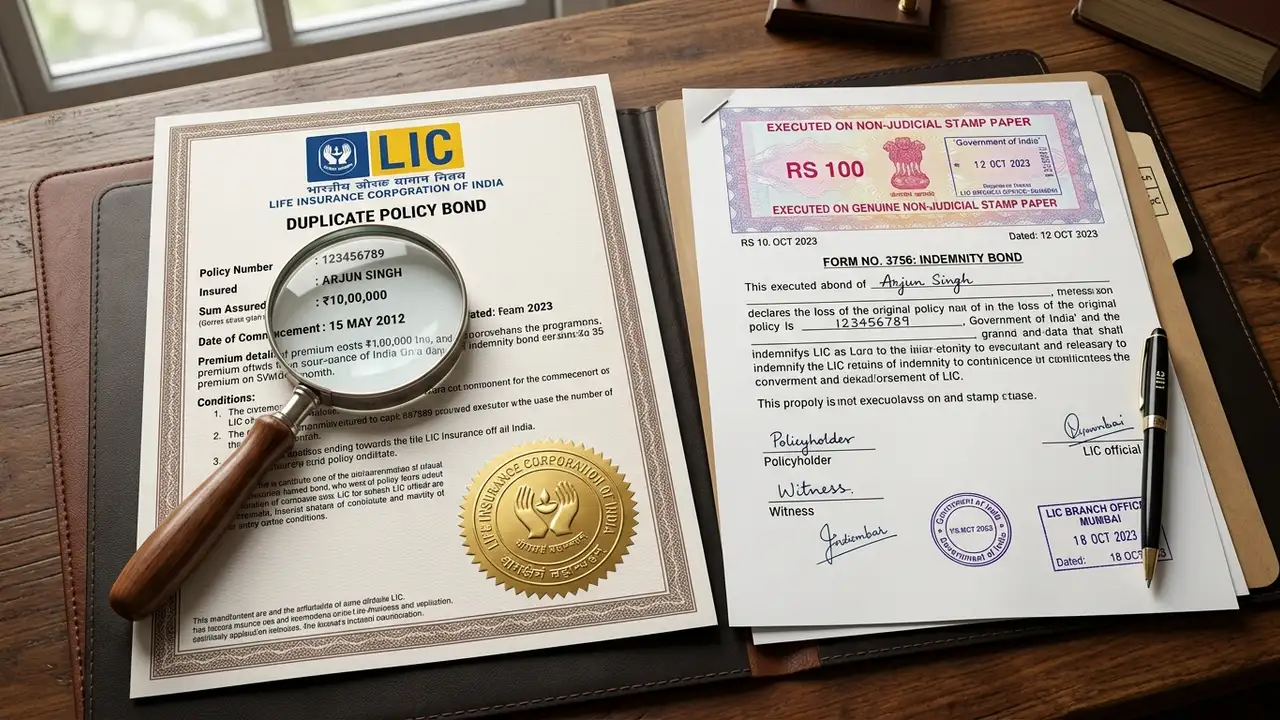
Discovering that your original Life Insurance Corporation of India (LIC) policy bond certificate is missing, destroyed, or lost in transit can trigger intense financial anxiety. For decades, the physical policy bond—officially designated as the Policy Schedule and Contract of Assurance under Section 2(9) of the Insurance Act, 1938—has stood as the indispensable legal deed required to claim maturity payouts, secure low-interest policy loans, or process policy surrenders.
However, misplacing your original document does not compromise your accumulated life insurance cover, nor does it extinguish the reversionary bonuses and final additional bonuses (FAB) credited to your policy account over decades. LIC maintains an established, legally codified procedure under its Policy Servicing Operations Manual to issue a genuine Duplicate Policy Bond or execute an Indemnity-Based Settlement.
This exhaustive, actuarially verified master guide breaks down the complete legal procedure for 2026. From retrieving forgotten policy numbers and executing Form No. 3756 (Indemnity Bond for Lost Policy) to calculating state-specific non-judicial stamp duty, securing solvent sureties, navigating public newspaper notices, and utilizing DigiLocker digital e-policies, this manual equips policyholders to resolve lost bond complications with zero bureaucratic delay.
1. Immediate Action Steps When an LIC Policy Bond Is Missing
Before initiating a formal application for a duplicate policy bond, policyholders must perform a systematic forensic audit of their records. Because securing a duplicate bond requires legal documentation, stamp duty expenditure, and potential newspaper advertising, taking immediate targeted steps can often uncover the document or eliminate unnecessary administrative costs.
Audit Previous Income Tax and Bank Safe Deposit Files
In over 40% of reported "lost bond" inquiries, the document is simply stored in archival financial folders. Systematically review old Section 80C investment proof dossiers submitted to your corporate employer, bank safe deposit locker envelopes, home purchase title deed files, and past Chartered Accountant audit packs.
Verify Prior Bank Collateral Assignments (Crucial Check)
A frequent reason policyholders cannot locate their original policy bond is that the policy was assigned as collateral security for a home loan, education loan, or commercial overdraft under Section 38 of the Insurance Act. If you pledged your policy to State Bank of India, HDFC Bank, ICICI Bank, or LIC Housing Finance, the original physical bond remains in the custodial vault of the lending bank under an Absolute Assignment until a formal Deed of Re-Assignment is registered. Check your loan closure documents.
Determine the Legal Classification of the Loss
LIC categorizes lost bonds into three operational streams, each with distinct evidentiary mandates:
- Accidental Misplacement / Untraceable: The bond was lost during home relocation, office shifting, or domestic reorganization. Requires an affidavit and Form 3756.
- Theft or Burglary: The document was stolen along with other valuables during a break-in or transit loss. Mandates a formal Police Complaint / General Diary (GD) or FIR copy.
- Total Physical Destruction: The document was destroyed by fire, monsoon flooding, or termite infestation. Requires local administrative certification (Fire Brigade report or Tehsildar certificate) to qualify for newspaper notice waiver.
Executing Form 3756 while deliberately concealing that the policy is pledged with a private financier or commercial lender constitutes criminal perjury and fraud under Sections 415 and 420 of the Indian Penal Code (or Bharatiya Nyaya Sanhita). LIC's Central Policy Audit cell verifies assignment registers against the central database before issuing duplicate parchment.
2. How to Retrieve Forgotten Policy Number (Without Policy Bond)
Applying for a duplicate policy bond or executing an indemnity deed requires your 9-digit LIC Policy Number. If the physical certificate is missing and you cannot recall your policy number, you cannot download forms or verify policy status. Fortunately, modern digital integration makes retrieving your policy number straightforward through multiple verified channels:
| Retrieval Channel | Required Input / Identifiers | Turnaround | Accessibility & Scope |
|---|---|---|---|
| LIC Customer Portal (Premier / Basic) | User ID / Mobile / Email + Password + DOB | Instant | Online dashboard lists all active, paid-up, and lapsed policies linked to your PAN and registered mobile. |
| Official LIC WhatsApp Bot (+91 8976862090) | Registered Mobile Number authentication via OTP | 30 Seconds | Interactive menu allows selecting "Policy Status" to display registered policy numbers and premium due dates. |
| Bank Statement / NACH Mandate Remark | Net banking transaction history or physical passbook | 5 Minutes | Premium auto-debit narration contains the exact 9-digit policy number (e.g. ACH/LIC OF INDIA/876543210). |
| Previous Income Tax Returns (ITR) | Form 16 or Section 80C Schedule in ITR filing acknowledgment | 10 Minutes | Past employer tax proof submission portals store scanned premium receipts showing policy numbers. |
| Servicing Branch Master Index Search | Physical PAN Card, Aadhaar Card, DOB, and Father's Name | Same-Day | Branch PS counter queries the All-India Central Inquiry Engine (e-FEAP) across all divisional databases. |
If you purchased your policy decades ago and never registered online, visit any LIC branch cash/servicing counter. Request an All-India Name Search on their computerized terminal. By entering your Full Name (as spelled on your proposal form), Date of Birth, and Father's Name, the system will instantly locate every policy docket registered under your profile nationwide.
3. Do You Always Need a Duplicate Bond? (Duplicate Bond vs Settlement Indemnity)
One of the costliest misunderstandings among policyholders is the belief that a physical duplicate policy bond is mandatory under all circumstances. In reality, LIC's Policy Servicing Operations Manual makes a critical actuarial distinction between Ongoing Policy Servicing and Terminal Settlement Claims.
Depending on where your policy stands in its lifecycle, you may be able to bypass the entire duplicate bond process—saving thousands of rupees in stamp duty and newspaper advertisement costs, as well as weeks of processing time.
| Parameter | Path A: Full Duplicate Policy Bond | Path B: Loss Indemnity at Settlement |
|---|---|---|
| When is This Path Chosen? | Policy has years remaining until maturity; premiums are active; needed for physical bank pledge. | Policy is maturing immediately, or being surrendered for cash, or death claim occurred. |
| Physical Bond Re-Issued? | Yes (Fresh bond with embossed seal printed) | No (Bond is permanently cancelled without printing) |
| Statutory Form Required | Form No. 3756 (Indemnity for Duplicate Bond) | Form 3756 / Indemnity Clause in Form 3825 (Maturity) or Form 5074 (Surrender) |
| Newspaper Ad Mandatory? | Mandatory (> ₹1 Lakh SA) | Frequently Waived |
| Estimated Cost & Expenses | ₹2,000 to ₹5,000 (Ad + Stamp + Fee) | ₹100 to ₹500 (Stamp paper only) |
| Turnaround Timeline | 30 to 45 Calendar Days (Ad waiting window) | 7 to 10 Working Days (Direct NEFT Settlement) |
The Golden Rule of Policy Servicing: Never apply for a physical duplicate policy bond if your objective is to surrender the policy or claim maturity proceeds. Printing a security-watermarked duplicate policy bond only to deliver it to the claims desk for immediate destruction and hole-punch cancellation wastes money. Instead, notify the branch claims manager that you are applying for Settlement Under Indemnity for Lost Bond.
4. Line-by-Line Guide to Form 3756 (Indemnity Bond for Issue of Duplicate Policy)
LIC Form No. 3756 (formally titled "Form of Indemnity Bond to be completed when a Policy is lost or misplaced and application is made for issue of a duplicate policy") is a legally binding contract under Section 124 of the Indian Contract Act, 1872. By executing this deed, the policyholder (Obligor) and their guarantor (Surety) jointly promise to protect LIC against any financial liability should the lost bond resurface.
Completing Form 3756 without clerical errors or legal ambiguity is essential for rapid processing by the divisional legal cell:
Header Identification & Policy Particulars
Record the exact Servicing Branch Code and Divisional Office. Enter the 9-digit Policy Number, Full Name of the Life Assured (in block capitals exactly matching the proposal docket), Full Name of the Proposer (if different, as in child plans), Sum Assured in figures and words, and the Table & Term of the policy.
The Preamble & Formal Recital of Loss
The legal recital declares that Policy No. [XXXXX] granted by the Life Insurance Corporation of India has been lost, mislaid, or destroyed and cannot be found despite diligent and exhaustive search. You must specify the estimated date or month when the document went missing and the location where it was last preserved.
Joint and Several Indemnity Covenant
Under this foundational legal clause, the Policyholder and the Surety bind themselves, their heirs, executors, administrators, and assigns jointly and severally to hold LIC harmless against all claims, actions, suits, losses, costs, charges, and expenses that the Corporation may incur by reason of issuing the duplicate policy certificate.
Undertaking for Immediate Surrender Upon Discovery
The Obligor gives an irrevocable undertaking that in the event the original policy bond is ever found, recovered, or comes into their hands or the hands of any person on their behalf, they will immediately deliver and surrender the original document to LIC for formal cancellation without delay.
Questionnaire Concerning Circumstances of Loss (Annexure)
The rear annexure contains specific statutory queries requiring unambiguous answers:
- Custody: In whose custody was the policy bond when it was last seen?
- Circumstances: How did the loss occur? (e.g., "Lost during domestic relocation from Pune to Bengaluru in July 2024; exhaustive search through household goods failed to trace the file").
- Encumbrance / Lien: Has the policy ever been assigned, pledged, or deposited with any bank, financier, or third party as security? (State "No, absolutely unencumbered").
Signatures, Witnesses & Notarial Attestation
The document concludes with the signatures of the Policyholder (Obligor) and the Surety. Two independent adult witnesses who personally know both parties must sign, writing their full legal names, occupations, and residential addresses. The entire instrument must then be attested by an authorized Notary Public or Oath Commissioner with an official seal.
5. Non-Judicial Stamp Paper Requirements: State-Wise Stamp Duty Matrix
Under the Indian Stamp Act, 1899 and the respective State Stamp Acts, an indemnity bond is an instrument chargeable with stamp duty. Executing Form 3756 on plain paper or on stamp paper of inadequate denomination renders the contract legally defective and inadmissible in evidence under Section 35 of the Stamp Act. LIC's legal desk will immediately reject under-stamped bonds.
Because stamp duty is an exclusive State Subject under Entry 44 of the Concurrent List (List III) of the Seventh Schedule to the Constitution of India, the exact required non-judicial stamp paper value varies across states:
| State / Union Territory | Governing State Stamp Act | Applicable Article | Prescribed Stamp Duty Value | Accepted Stamp Mode |
|---|---|---|---|---|
| Maharashtra | Maharashtra Stamp Act, 1958 | Article 34 (Indemnity Bond) | ₹500 | e-Stamp (SHCIL) / Franking |
| Delhi (NCT) | Indian Stamp Act (Delhi Amendment) | Article 34 (Indemnity Bond) | ₹100 | e-Stamp (SHCIL) |
| Karnataka | Karnataka Stamp Act, 1957 | Article 29 (Indemnity Bond) | ₹200 to ₹500 | e-Stamp Certificate |
| Uttar Pradesh | UP Stamp Act (Schedule 1-B) | Article 34 (Indemnity Bond) | ₹100 | e-Stamp / Physical Stamp |
| West Bengal | Bengal Stamp Act, 1935 | Schedule 1A (Indemnity Bond) | ₹100 | e-Stamp (GRIPS) / Stamp |
| Tamil Nadu | Tamil Nadu Stamp Act, 1899 | Article 34 (Indemnity Bond) | ₹100 to ₹200 | e-Stamp Certificate |
| Gujarat | Gujarat Stamp Act, 1958 | Article 33 (Indemnity Bond) | ₹300 | e-Stamp (SHCIL) |
| Rajasthan | Rajasthan Stamp Act, 1998 | Article 31 (Indemnity Bond) | ₹500 | e-Stamp (GRAS) / Stamp |
| Telangana & Andhra Pradesh | Indian Stamp Act (AP/TS Amendments) | Article 29 (Indemnity Bond) | ₹100 | Non-Judicial Stamp Paper |
When purchasing an e-Stamp certificate from an authorized Stock Holding Corporation of India Limited (SHCIL) counter, bank branch, or online stamp vendor, ensure the certificate metadata is recorded as follows:
• Description of Document: Indemnity Bond (Form 3756)
• First Party Name: [Your Full Legal Name as Policyholder]
• Second Party Name: Life Insurance Corporation of India
• Stamp Duty Paid By: [Policyholder Name]
Attach the e-Stamp certificate as the first page, followed by the printed Form 3756 text.
6. Surety / Guarantor Rules: Who is Eligible to Sign as Surety?
A critical element of Form 3756 is the Surety (Guarantor). Under Section 126 of the Indian Contract Act, a contract of guarantee involves a promise by the surety to discharge the liability of the principal debtor in case of default. In life insurance administration, the surety guarantees that if the original bond was fraudulently negotiated or a legitimate third party surfaces with a valid claim, the surety is personally liable to repay the indemnified amount to LIC.
To ensure that the guarantee is legally substantive rather than nominal, LIC enforces strict solvency criteria:
Eligible Individuals for Surety
- Government & PSU Employees: Permanent staff of Central Government, State Governments, Public Sector Banks, Railways, or Defense.
- Corporate Salaried Professionals: Confirmed employees of reputed private companies, MNCs, or listed entities with steady income.
- Tax-Paying Professionals: Practicing Chartered Accountants, Doctors, Advocates, or Engineers with valid professional certificates.
- Independent Business Persons / Property Owners: Self-employed individuals with active ITR filings or clear title deeds to immovable property.
- Financial Threshold: Annual gross income or net worth must be equal to or exceed the policy's Basic Sum Assured.
Ineligible Individuals (Strictly Disqualified)
- Financially Dependent Relatives: Non-working spouses, homemakers without independent assets, dependent elderly parents, or minor children.
- LIC Field Personnel: Licensed LIC Agents, Development Officers, or Clerical Staff attached to the same servicing branch (to prevent conflict of interest).
- Insolvent / Undischarged Debtors: Anyone facing bankruptcy proceedings, court recovery notices, or active loan defaults.
- Non-Resident Individuals (NRIs): Foreign nationals or persons residing overseas without permanent immovable assets in India.
Mandatory Evidentiary Dossier from the Surety:
- Completed and signed Declaration of Solvency section within Form 3756.
- Self-attested identity proof (PAN Card) and address proof (Aadhaar Card, Passport, or Voter ID).
- For Salaried Sureties: Latest 3 months' salary slips, Form 16, and corporate employee photo ID card copy.
- For Business / Self-Employed Sureties: Latest 2 assessment years' Income Tax Return (ITR-V) verification forms with computational sheets, or latest paid Municipal Property Tax receipt.
Yes. Under LIC Operating Circulars, the Branch Manager or Senior Divisional Manager (SDM) possesses discretionary authority to waive the surety requirement in specific circumstances:
1. The policy is fully paid-up with a low Basic Sum Assured (typically under ₹50,000 to ₹1,00,000).
2. The policyholder is a Gazetted Government Officer, Magistrate, or senior PSU executive of proven integrity.
3. The loss occurred during a documented natural calamity (flood, earthquake, tsunami) or catastrophic fire, supported by an official Government rehabilitation certificate.
7. Public Newspaper Notice Guidelines: When Mandatory vs Waived
The primary legal risk for LIC in issuing a duplicate policy bond is the potential existence of an undisclosed equitable mortgage or private pledge. If an unscrupulous policyholder borrows money from a private financier, deposits their original bond as security, and subsequently obtains a duplicate bond from LIC, the lender's security is compromised, creating protracted litigation.
To preempt such third-party claims, LIC mandates publishing a Public Newspaper Notice inviting objections before printing a duplicate instrument.
| Sum Assured & Risk Tier | Newspaper Advertisement Mandate | Competent Approval Authority | Operational Conditions |
|---|---|---|---|
| Up to ₹1,00,000 (Low Risk) | Waiver Permitted | Branch Manager (Scale I / II) | Waived automatically upon submission of Form 3756 with a solvent surety and satisfactory inspection of policy docket. |
| ₹1,00,001 to ₹5,00,000 (Medium Risk) | Mandatory / Discretionary | Assistant Divisional Manager / Manager (PS) | Public notice mandatory unless loss is certified by Police Non-Traceable Report or Fire Brigade report. |
| Above ₹5,00,000 (High Risk) | Strictly Compulsory | Senior Divisional Manager (SDM) | Must be published in two daily newspapers at policyholder's expense with a full 30-day objection window. |
Rules Governing Newspaper Publication:
- Dual Newspaper Rule: When mandatory, the notice must appear in two distinct publications circulating in the town/district where the policyholder resides or where the servicing branch operates:
- One prominent, widely circulated English language daily (e.g., The Times of India, The Indian Express, or The Hindu).
- One prominent regional vernacular daily (e.g., Dainik Jagran, Maharashtra Times, Eenadu, Daily Thanthi, or Anandabazar Patrika).
- Mandatory 30-Day Waiting Window: LIC cannot print or issue the duplicate bond until 30 calendar days have elapsed from the publication date. If no third party lodges a formal legal objection or caveat with the Branch Manager during this window, the file is cleared for printing.
- Submission of Proof: The policyholder must purchase and submit the full, uncut original pages of both newspapers. Clipped snippets are rejected because the masthead, publication date, and page number must remain intact for audit verification.
Standard LIC Approved Public Notice Text:
"PUBLIC NOTICE IS HEREBY GIVEN that Policy No. [Insert 9-Digit Policy No.] on the life of [Insert Policyholder Name] issued by the Life Insurance Corporation of India, [Insert Branch Name & Code] for a Sum Assured of ₹[Insert Amount] has been lost / misplaced. Application has been made to the Corporation for the issue of a duplicate policy bond.
Notice is hereby given that any person/institution having any claim, lien, right, or objection in respect of the said policy should communicate the same in writing with supporting documentary evidence to the Branch Manager, LIC of India, [Insert Branch Address] within 30 days from the date of publication of this notice, failing which the Corporation will proceed to issue a duplicate policy bond, and the original policy document shall thereafter be deemed cancelled and null and void."
Date: [DD/MM/YYYY] | Place: [City] | Name of Applicant: [Policyholder Name]
8. Comprehensive Cost Breakdown: Fees, Stamp Duty, Ad Costs & GST
Securing a duplicate policy bond incurs specific statutory, administrative, and advertising expenses. To help you budget accurately, the table below provides a comprehensive actuarial cost breakdown:
| Cost Component | Statutory Basis / Authority | Payable Amount | Recipient / Payment Mode |
|---|---|---|---|
| Form 3756 Application Form | LIC Servicing Rules | ₹0 (Free) | Download free from portal or collect from branch servicing counter. |
| Corporation Duplicate Policy Fee | LIC Manual of Administrative Charges | ₹50 to ₹100 (+ 18% GST) | Paid directly at the LIC branch cash counter against a computer-generated receipt (BOC). |
| Fresh Policy Stamp Duty | Indian Stamp Act (Article 47 - Life Insurance) | ₹0.20 to ₹0.40 per ₹1,000 SA | Adhesive policy stamps affixed to the duplicate bond parchment and cancelled by branch manager. |
| Non-Judicial Stamp Paper (Form 3756) | Respective State Stamp Duty Acts | ₹100 to ₹500 | Purchased from licensed stamp vendors or SHCIL e-stamp portals. |
| Notary Public / Attestation Charges | Notaries Act, 1952 | ₹150 to ₹350 | Paid directly to the practicing Advocate / Notary Public for verification and swearing. |
| Classified Newspaper Advertisements | Commercial Advertising Tariffs (2 Dailies) | ₹1,500 to ₹4,500 (if mandatory) | Paid to authorized advertising agencies or newspaper front offices (₹0 if waived). |
Scenario A: ₹1,00,000 Sum Assured Policy (Ad Waived)
• Duplicate Policy Fee & GST: ₹59
• Fresh Policy Stamp Duty: ₹40
• Non-Judicial Stamp Paper (e-Stamp): ₹100
• Notary Attestation Fee: ₹150
• Newspaper Notice: ₹0 (Waived)
• Total Out-of-Pocket Expense: ₹349
Scenario B: ₹10,00,000 Sum Assured Policy (Ad Compulsory)
• Duplicate Policy Fee & GST: ₹118
• Fresh Policy Stamp Duty: ₹400
• Non-Judicial Stamp Paper (e-Stamp): ₹500
• Notary Attestation Fee: ₹250
• Dual Newspaper Classified Notices: ₹2,800
• Total Out-of-Pocket Expense: ₹4,068
9. Turnaround Time & Collection: Verification, Audit & Physical Issuance
The lifecycle of issuing a duplicate policy bond follows a structured administrative pipeline within LIC's branch operating hierarchy:
Days 1 to 3: Application Scrutiny & Cash Fee Acceptance
Submit the executed Form 3756 dossier, stamp paper, surety documents, and KYC proofs at your home servicing branch counter. The servicing official verifies identity credentials, checks signature consistency against the proposal microfilm records, and directs you to the cash counter to pay the administrative fee and policy stamp duty. You receive a stamped Branch Office Collection (BOC) receipt.
Days 4 to 7: Actuarial Verification & Public Notice Direction
The Policy Servicing Superintendent audits the policy ledger. If the Sum Assured is eligible for waiver, the Branch Manager executes an official waiver order. If advertising is mandatory, the branch issues a formal Draft Public Notice specifying the policy details and authorized newspaper language.
Days 8 to 38: The Statutory 30-Day Public Objection Period
(Applicable only if newspaper notices were published). After publishing the notices, submit full uncut newspaper sheets to the branch. The branch holds the file for exactly 30 calendar days to await any third-party objection. If the advertisement was waived, this stage is bypassed completely, saving 30 days.
Days 39 to 42: Printing, Stamping & Corporate Seal Embossing
Once cleared, the branch printing terminal generates the duplicate policy bond on official security parchment. Fresh adhesive policy stamps are affixed and cancelled. The Branch Manager signs the document and imprints the official brass corporate seal alongside a prominent red endorsement stamp:
"DUPLICATE POLICY ISSUED IN LIEU OF ORIGINAL POLICY NO. [XXXXX] DATED [XX/XX/XXXX] WHICH IS REPORTED LOST/DESTROYED."
Physical Collection Protocols:
- In-Person Collection: The primary policyholder should visit the branch servicing counter with original photo KYC (PAN or Aadhaar) and the original BOC fee receipt. Sign the duplicate policy register to acknowledge receipt.
- Postal Dispatch via Speed Post: If requested in writing, the branch will dispatch the duplicate bond via Speed Post or Registered A.D. to your registered postal address, providing a consignment tracking number via SMS.
10. Digital Alternative: Accessing and Downloading e-Policy Document via DigiLocker
Under the Government of India's Digital India framework and the Insurance Regulatory and Development Authority of India (Protection of Policyholders' Interests) Regulations, policyholders are no longer entirely dependent on physical paper documents for day-to-day policy servicing.
Pursuant to Section 5A of the Information Technology Act, 2000 read with Rule 9A of the Information Technology (Preservation and Retention of Information by Intermediaries Providing Digital Locker Facilities) Rules, 2016, documents retrieved and hosted in DigiLocker enjoy statutory equivalence with original physical certificates issued by authorities.
Log in to Your Authenticated DigiLocker Account
Open the official DigiLocker mobile application (iOS/Android) or visit digilocker.gov.in. Authenticate using your Aadhaar-linked mobile OTP or biometric credentials.
Search and Select Life Insurance Corporation of India
Navigate to "Search Documents" → Category: "Banking & Insurance" → Select "Life Insurance Corporation of India (LIC)".
Query Your Digital Policy Schedule
Select the document type: "Policy Document". Enter your 9-digit LIC Policy Number and your Date of Birth in DD/MM/YYYY format. Grant consent for UIDAI data sharing.
Download Digitally Signed Cryptographic e-Policy
DigiLocker queries LIC's central policy database via secure API and pulls the digitally signed PDF certificate bearing LIC's cryptographic public key infrastructure (PKI) digital signature.
| Use Case / Transaction Type | DigiLocker e-Policy Accepted? | Physical Bond / Form 3756 Still Required? |
|---|---|---|
| Income Tax Section 80C Deduction Proof | 100% Accepted | No |
| Online Policy Revival via Customer Portal | 100% Accepted | No |
| Address / Mobile / Nominee Change Online | 100% Accepted | No |
| Online Policy Loan (LIC Premier Services) | Accepted via e-Sign | No |
| Commercial Bank Assignment for Home Loan | Rejected by Banks | Yes (Physical duplicate bond required for endorsement) |
| Maturity Claim Payout at Branch Counter | Accepted with Indemnity | Physical duplicate not needed (Indemnity settlement) |
Content validated against the Indian Contract Act 1872 (Section 124), Indian Stamp Act 1899, Information Technology Act 2000 (Section 5A), and Life Insurance Corporation of India Policy Servicing Operating Manuals (2025-2026).