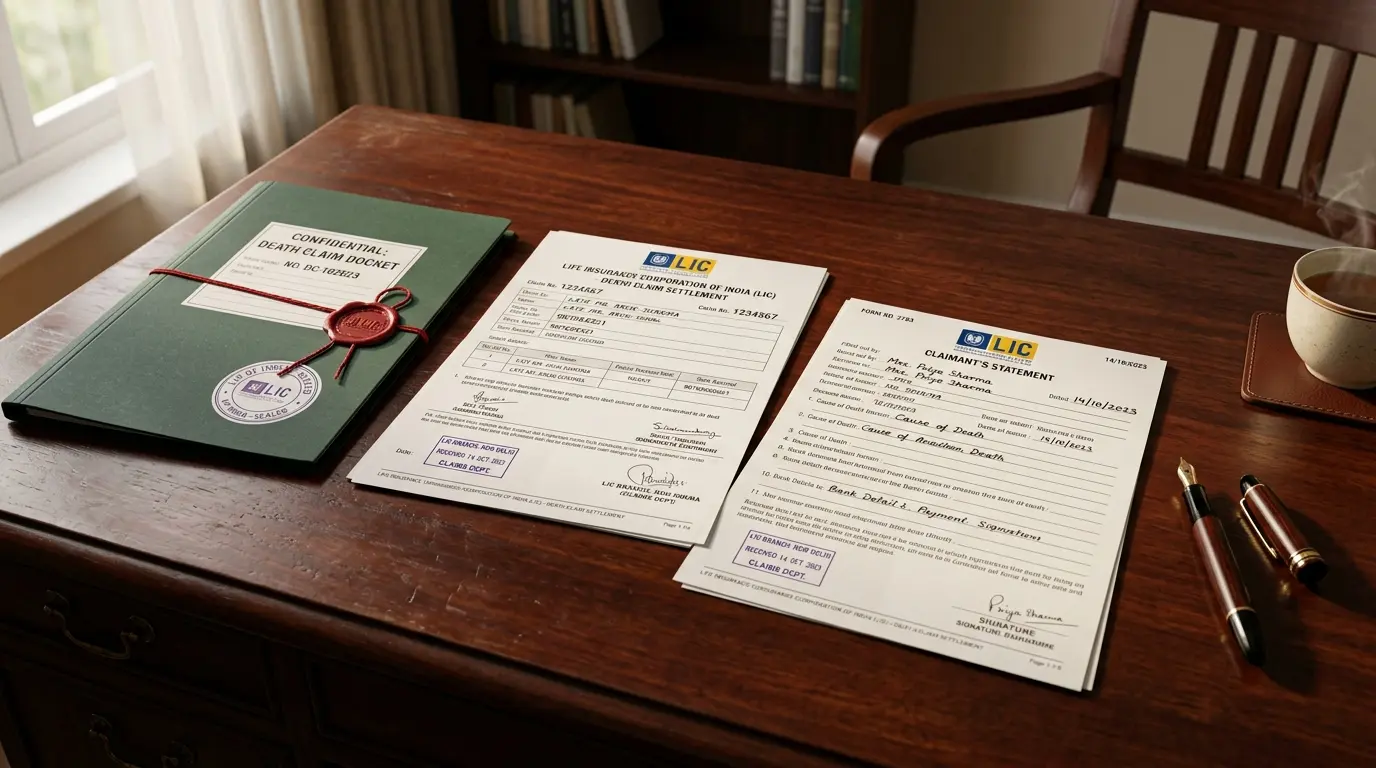
The untimely demise of a breadwinner is a catastrophic emotional shock for any Indian family. During this vulnerable transition, life insurance acts as the ultimate financial safety net, designed to replace lost income, extinguish home mortgages, and fund children's higher education. The Life Insurance Corporation of India (LIC) settles over 98% of death claims presented to it every year. However, navigating the bureaucratic claim discharge process often triggers intense anxiety for grieving nominees, especially when faced with archaic forms, legal stamp requirements, hospital verifications, and regulatory investigations.
This exhaustive, actuarially verified operational manual details the complete legal framework and procedural roadmap to claim an LIC death benefit in 2026. From deciphering Form No. 3783 (Claimant's Statement) and executing revenue stamps to invoking the Section 45 3-year incontestability shield, handling pre-deceased nominees, and securing 100% tax-exempt NEFT settlements within IRDAI turnaround timelines, this guide provides complete, unassailable clarity for policy beneficiaries.
1. Statutory Mandate & Legal Entitlement of Nominees
A life insurance contract is a tripartite legal instrument executed between the insurer (LIC of India), the Life Assured (proposer), and the designated Nominee (Beneficiary) under Section 39 of the Insurance Act, 1938. Following the death of the life assured, the entire contractual ownership of the death proceeds shifts to the nominee. However, Indian jurisprudence draws a vital distinction between two classes of nominees that every family must understand:
Introduced by the landmark Insurance Laws (Amendment) Act, 2015. If the nominee is the policyholder's spouse, children, or parents (or combinations thereof), they are statutorily recognized as Beneficial Nominees. They become the absolute legal owners of the death claim proceeds to the complete exclusion of all other legal heirs, wills, or succession disputes.
If a distant relative (brother, sister, nephew), business associate, or friend is nominated, they remain a Collector Nominee under the historic Supreme Court ruling in Sarbati Devi v. Usha Devi (1984 1 SCC 424). They are authorized to collect the payout from LIC, but hold the money in fiduciary trust for the deceased's legal heirs under general personal succession laws.
Under Section 39(7), death claim proceeds payable to a Beneficial Nominee cannot be attached by civil court decrees, personal loan creditors, or business lenders, unless the policy was formally assigned to a financial institution as loan collateral prior to demise. The beneficial nominee enjoys sovereign statutory priority over general unsecured debts.
2. Early vs Non-Early Claims & Section 45 Incontestability Shield
When an intimation of death reaches an LIC claims division, the actuarial terminal immediately categorizes the claim into one of two statutory regimes based on the duration elapsed since policy commencement:
| Feature | Non-Early Death Claim (> 3 Years) | Early Death Claim (≤ 3 Years) |
|---|---|---|
| Duration Elapsed | Demise occurs after 3 full years from date of issuance or revival | Demise occurs within 3 years of policy commencement or revival |
| Section 45 Protection | 100% Incontestable (Ironclad Legal Shield) | Contestable (Insurer entitled to investigate fraud/concealment) |
| Investigation Triggered? | No forensic field investigation allowed | Mandatory investigation by LIC Claims Inquiry Officer |
| Forms Required | Form 3783 + Death Certificate + Bond + KYC + NEFT | Form 3783 + Form 3784 + Form 3785 + Form 3815 + Medical History |
| Processing Timeline | Settled within 15 to 30 days | Up to 90 to 120 days (inclusive of medical inquiry) |
| Repudiation Grounds | ZERO repudiation permitted on medical misstatement | Permitted only if fraudulent suppression of material disease is proven |
2.1 The Landmark Section 45 Three-Year Incontestability Shield
Under the amended Section 45 of the Insurance Act, 1938, Indian law provides absolute, unconditional protection to policyholders through the 3-Year Incontestability Clause:
Statutory Text: Section 45(1) Insurance Act 1938:
"No policy of life insurance shall be called in question on any ground whatsoever after the expiry of three years from the date of the policy, i.e., from the date of issuance of the policy or the date of commencement of risk or the date of revival of the policy or the date of the rider to the policy, whichever is later."
The phrase "on any ground whatsoever" is absolute. Even if the insurer alleges that the policyholder suppressed hypertension, diabetes, pre-existing cardiac surgery, or family medical history at the time of proposal, once 3 years have elapsed, LIC is statutorily prohibited from repudiating the claim or initiating field inquiries.
2.2 Early Death Claim Investigation Protocols (≤ 3 Years)
If the policyholder passes away within 36 months of taking the policy or reviving a lapsed policy, the law permits LIC to verify whether there was fraudulent concealment of material facts. Under Section 45(2), repudiation is legally valid ONLY if LIC conclusively establishes three cumulative hurdles:
- 1. Materiality: The suppressed fact was material to the underwriting risk (e.g. active malignancy, renal failure, chronic liver disease). Minor ailments like seasonal viral fever or common sprains do NOT constitute material suppression.
- 2. Fraudulent Intent: The policyholder deliberately, knowingly, and fraudulently concealed the fact with intent to deceive the Corporation.
- 3. Pre-Existing Knowledge: The policyholder had documented clinical knowledge of the illness prior to signing the proposal form.
Policyholders must note that if a policy lapsed due to non-payment and was subsequently revived on submission of a Declaration of Good Health (Form 680), the 3-year clock under Section 45 resets from the exact date of revival. If demise occurs within 3 years of revival, the claim is treated as an Early Claim subject to forensic verification.
3. Death Intimation: Timelines, Branch Protocols & Online Alerts
Initiating a death claim promptly ensures that LIC's central operations system immediately halts premium deduction notices, stops NACH auto-debits, and generates the official claim docket.
3.1 Who Can Submit the Death Intimation?
The formal intimation of death can be lodged by:
- The registered Primary Nominee or Beneficial Nominee.
- The appointed Legal Guardian / Appointee (if the registered nominee is a minor below 18 years of age).
- Any Class-I Legal Heir (Spouse, Son, Daughter, Mother) if no valid nomination exists.
- The servicing LIC Agent or Development Officer on behalf of the family.
3.2 Where and How to Lodge the Intimation
In-Person at Home Servicing Branch (Fastest Route)
Submit the written death intimation letter directly at the Claims & Policy Servicing Counter of the home branch where the policy was originally issued. The branch claims desk provides an immediate rubber-stamped acknowledgment slip with an official Claims Inward Number.
Any Computerized LIC Branch Across India
Under LIC's Enterprise Document Management System (EDMS), any branch in India can accept the death intimation and register it online on the central server, digitally routing the claim docket to the home branch within 48 hours.
Registered / Speed Post with Acknowledgment Due
Nominees residing in different cities or abroad can send the death intimation letter along with a certified copy of the death certificate via Speed Post addressed to The Chief Manager (Claims), LIC of India, [Home Branch Code].
Essential Information Checklist for Death Intimation Letter:
- • Policy Number(s): All policy numbers held by the deceased across all LIC branches.
- • Deceased Life Assured Details: Full Name, Date of Birth, and Father's/Spouse's Name.
- • Date, Time & Place of Death: Exact calendar date, time, and precise location (e.g., Apollo Hospital, New Delhi or Residential Address).
- • Cause of Death: Natural illness (cardiac arrest, respiratory failure), sudden trauma, accidental road injury, or illness.
- • Claimant Information: Nominee's full name, relationship, verified mobile number, email address, and complete correspondence postal address.
4. Line-by-Line Guide to Form 3783 (Claimant's Statement)
LIC Form No. 3783 (Claimant's Statement) is the foundational legal document executed by the nominee. It serves as the formal petition for settlement and statutory discharge of contractual liability. Completing this multi-page form accurately prevents administrative rejection:
Particulars of the Deceased Life Assured
Record the exact full name of the deceased as printed on the policy bond. Write the permanent residential address, occupation, employer name (if salaried), and precise date and hour of death. Specify whether the death occurred at home or in an inpatient medical facility.
Medical History & Final Illness Particulars
Detail the exact nature of the disease or fatal ailment. State the date when symptoms were first detected, the duration of the final illness, and list the names, clinic addresses, and medical registration numbers of all consulting physicians and surgeons who attended the deceased during their last illness.
Disclosure of Other Insurance Policies
Mandatory disclosure table. State all other insurance policies held by the deceased with LIC or any private life insurer (HDFC Life, ICICI Prudential, SBI Life, Max Life). List policy numbers, basic sums assured, issuing branch offices, and whether concurrent claims have been filed.
Claimant / Nominee Identification & Title
Specify your legal capacity to claim: "Nominee under Section 39", "Appointee for Minor Nominee", or "Class-I Legal Heir". Enter your full name, age, date of birth, marital status, residential address, PAN number, and mobile number.
Revenue Stamp Execution & Signature
Under the Indian Stamp Act, 1899, the claimant must affix an official ₹1.00 (One Rupee) Revenue Stamp in the designated bordered box on the final page. The claimant must sign diagonally across the revenue stamp such that part of the signature rests on the paper and part across the face of the stamp. An un-stamped discharge is legally void.
Authorized Witness Attestation
The claimant's signature or Left Thumb Impression (LTI) must be attested by a person of competent public standing: Gazetted Officer, LIC Development Officer, Branch Manager, Advocate, Bank Manager, or School Headmaster. The witness must sign, print their designation, official seal, and date.
5. Medical & Employer Verification Forms: Form 3784, 3785 & 3815
In all Early Death Claims (≤ 3 years) and in cases where the cause of death requires clinical substantiation, LIC's claims division issues supplementary statutory verification forms that must be completed by independent medical and administrative authorities:
Form No. 3784: Medical Attendant's Certificate
Attending PhysicianMust be completed and signed by the registered medical practitioner who attended the deceased during the final illness immediately preceding death.
- • Clinical Diagnosis: Exact primary cause of death (e.g. Myocardial Infarction) and secondary contributory conditions (e.g. Diabetic Ketoacidosis).
- • Symptom Timeline: Exact date when symptoms were first experienced and reported by the patient.
- • Prior Consultations: Whether the deceased had been treated by other physicians previously for hypertension, cardiovascular illness, or nephropathy.
- • Doctor Credentials: Full name, medical council registration number, clinic address, and rubber stamp of the doctor.
Form No. 3785: Certificate of Hospital Treatment
Hospital SuperintendentMandatory if the policyholder was admitted as an inpatient in any hospital, nursing home, or specialized clinic prior to demise.
- • Admission & Demise Records: Exact date and minute of admission, and certified date and minute of death.
- • Indoor Case Sheet (IPD Records): Complete certified copy of inpatient treatment notes, ICU chart, temperature/vitals log, and surgical records.
- • Provisional vs Final Diagnosis: Comparison between the admission complaint and final clinical cause of death.
- • Certification: Executed by the Medical Superintendent, Hospital Administrator, or Head of Medical Records Department (MRD) with hospital seal.
Form No. 3815: Certificate of Employer
Salaried / Corporate HRCompulsory for all salaried individuals working in central/state government, public sector undertakings (PSUs), banks, or registered corporate private enterprises.
- • Leave Register Audit: Certified statement of all leaves availed by the deceased during the preceding 3 to 5 years, specifically categorizing Casual Leave, Earned Leave, Sick Leave, and Leave on Loss of Pay (LWP).
- • Medical Certificates on Record: Copies of medical certificates submitted by the employee to HR when seeking sick leaves.
- • Annual Health Checkups: Records of periodic corporate occupational health screenings or pre-employment medical examinations.
6. Accidental Death Rider Claims: Mandatory Police Dossier
If the deceased policyholder opted for the Accidental Death & Disability Benefit (ADDB) Rider or New Term Assurance Rider, the nominee is contractually entitled to receive an additional Accidental Sum Assured—effectively doubling the base death payout (up to the Corporation's maximum rider ceiling of ₹1 Crore to ₹2 Crore).
Under the contractual terms of the rider, an accident is legally defined as: "An event caused by outward, violent, and visible means, resulting directly and independently of all other causes in the death of the life assured within 180 days of the injury occurrence."
Mandatory Police & Forensic Dossier for Accidental Death Rider:
1. Certified First Information Report (FIR)
Copy of the FIR registered under Bharatiya Nagarik Suraksha Sanhita / CrPC at the jurisdictional police station immediately following the accident.
2. Inquest Report & Spot Panchnama
Police spot inspection report detailing accident scene conditions, vehicle collision points, road skid marks, and physical positioning of the deceased.
3. Post-Mortem Examination Report (PMR)
Complete autopsy protocol conducted by a Government Forensic Medical Officer, establishing traumatic external injuries as the direct cause of death.
4. Viscera Chemical / Toxicology Report
Forensic laboratory chemical analysis report confirming the absence of lethal alcohol, narcotics, poisons, or intoxicating substances.
5. Police Final Closure Report / Charge Sheet
Final judicial investigation summary confirming whether the fatality was purely accidental, vehicular negligence, or criminal homicide.
6. Valid Driving Licence of Deceased
Compulsory if the deceased was driving the motorized two-wheeler or four-wheeler at the time of the fatal crash.
LIC will repudiate the additional accidental rider sum assured (while still disbursing the base sum assured) if the post-mortem or police report proves:
- Intoxication / Drunk Driving: Blood alcohol level exceeding 30 mg per 100 ml of blood (Section 185 Motor Vehicles Act).
- Suicide / Self-Inflicted Injury: Suicide is 100% excluded under accidental riders, even after the 1-year policy suicide clause expires.
- Violation of Law: Demise while committing a crime, evading police arrest, or participating in civil riots.
- Aviation Hazards: Demise in private aviation or aerial activities (other than as a fare-paying passenger on commercial scheduled airlines).
7. Mandatory Physical Document Dossier Checklist
When submitting the formal claim packet to your servicing LIC branch, compile the following physical document dossier:
Original Municipal Death Certificate
Issued by the Municipal Corporation, Nagar Nigam, Gram Panchayat, or Registrar of Births and Deaths under the Registration of Births and Deaths Act, 1969. Must bear the official QR code or registrar's physical seal.
Original Physical Policy Document (Bond)
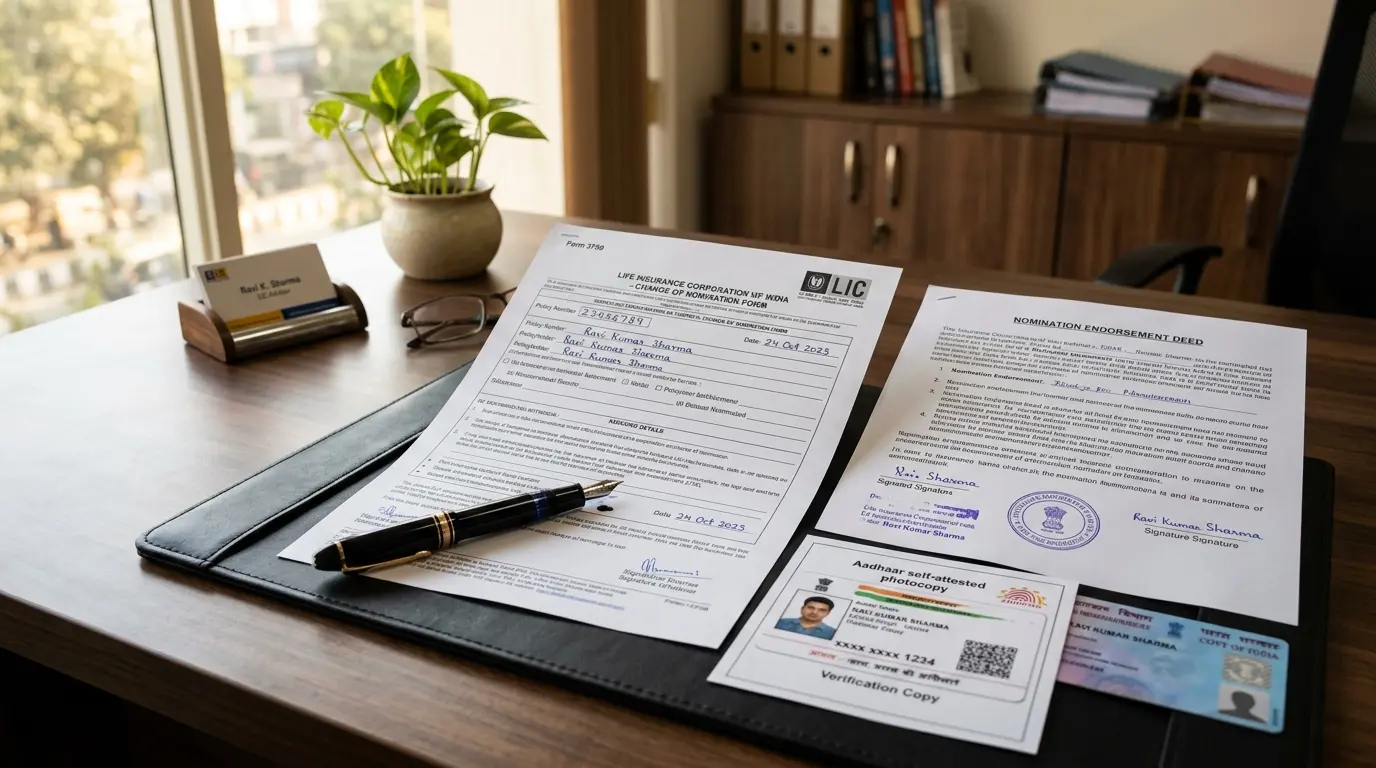
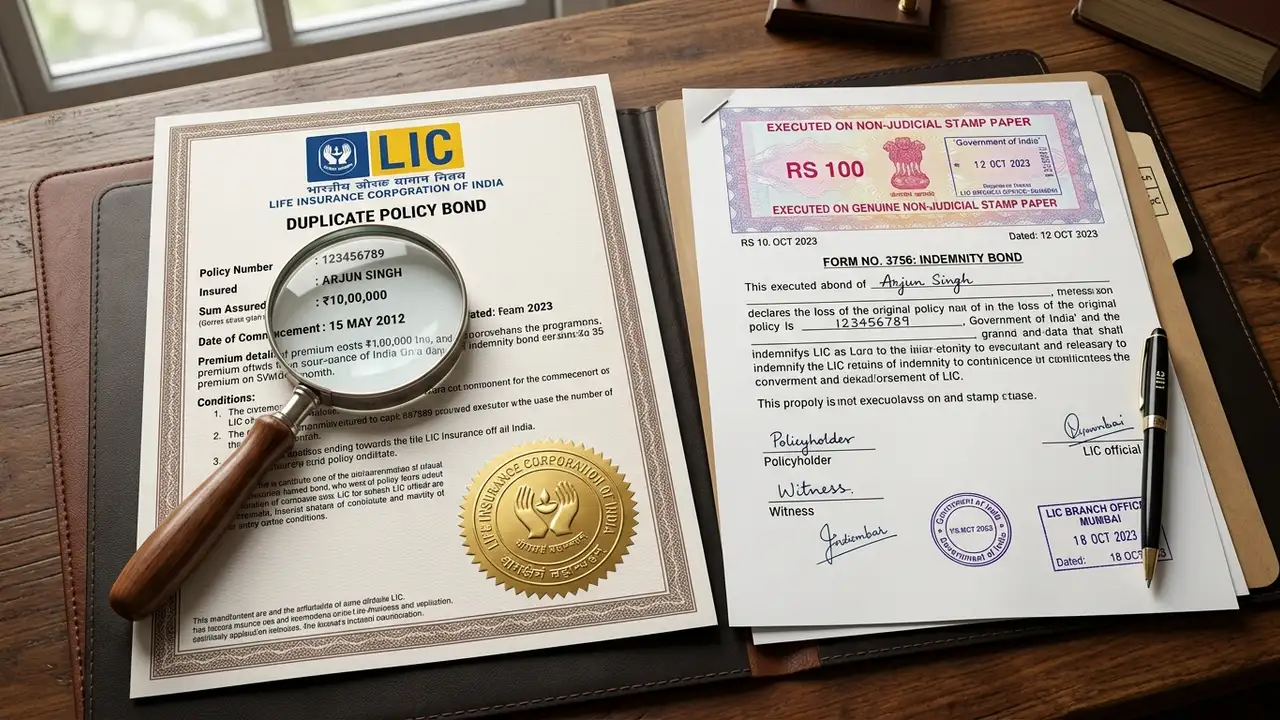
The original stamped policy bond issued when the proposal was accepted. If lost or destroyed, submit Form No. 3756 (Indemnity Bond for Lost Policy Bond) executed on non-judicial stamp paper with solvent sureties.
Duly Executed Form No. 3783 (Claimant's Statement)
Completely filled, signed across a ₹1.00 revenue stamp, and certified by an authorized witness.
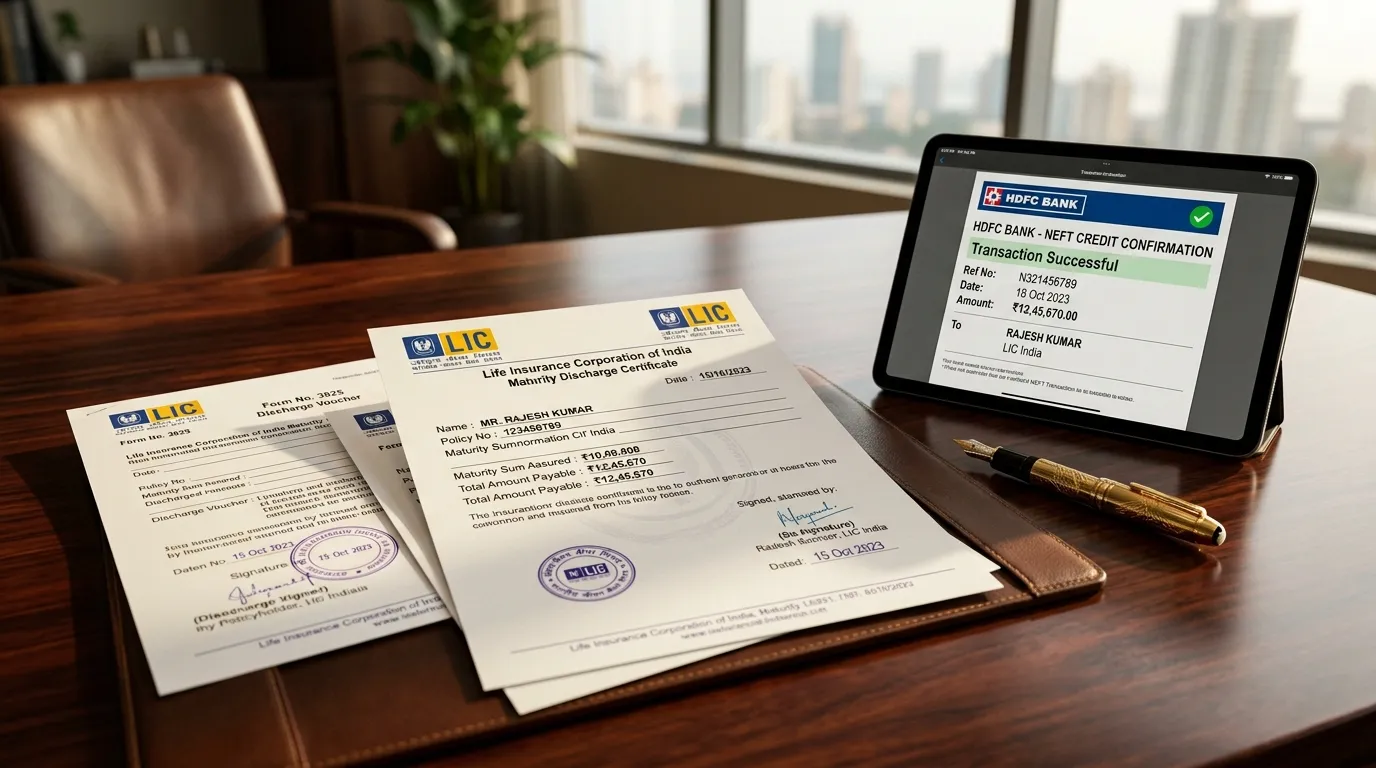
NEFT Mandate Form & Cancelled Cheque Leaf
Personalized cancelled cheque leaf with the nominee's name pre-printed, bank account number, and IFSC code. If the cheque is unpersonalized, attach a self-attested copy of the bank passbook's front page with recent entries.
Nominee KYC Dossier (PAN & Aadhaar)
Self-attested copies of the nominee's PAN Card and Aadhaar Card (or Passport / Voter ID) for Anti-Money Laundering (AML) compliance.
Age Proof of Deceased (if not previously admitted)
If the policy bond shows "Age Not Admitted," submit certified age proof of the deceased (School Leaving Certificate, 10th Class Marksheet, Passport, or Birth Certificate) to finalize actuarial calculation.
Authentic Numerical Case Study: Jeevan Anand (Plan 915) Death Claim Settlement
• Deceased Policyholder: Late Shri Vikramaditya Rao
• Basic Sum Assured: ₹25,00,000 | Policy Term: 20 Years
• Demise Timing: 7th Policy Year (Natural Cardiac Arrest — Non-Early Claim under Section 45)
• Vested Reversionary Bonuses (7 years @ ₹45/thousand avg): 7 × (2,500 × 45) = ₹7,87,500
• Final Additional Bonus (FAB): Not applicable (policy ran for less than 15 years)
• Accidental Death Benefit Rider: Not triggered (Natural death)
• Outstanding Policy Loan: ₹2,50,000 Principal + ₹11,875 accrued interest = ₹2,61,875
• Gross Claim Entitlement: ₹25,00,000 + ₹7,87,500 = ₹32,87,500
• Net NEFT Disbursed to Nominee: ₹32,87,500 - ₹2,61,875 = ₹30,25,625 (100% Tax-Free under Section 10(10D)).
The entire net amount was credited directly to the widow's bank account within 18 days of document submission.
8. Pre-Deceased Nominee or No Nominee: Succession & Legal Heirs
What happens when the designated nominee passed away before the policyholder, or died simultaneously, or no nomination was ever recorded on the proposal form? Indian succession law governs these scenarios:
Scenario A: Nominee Died Before the Policyholder (Pre-Deceased Nominee)
Under Section 39 of the Insurance Act, nomination is a personal license that automatically becomes legally extinguished upon the death of the nominee during the policyholder's lifetime. If the policyholder failed to execute a fresh nomination with LIC before their demise, the policy becomes an "Un-Nominated / Open Claim". The heirs of the pre-deceased nominee have zero legal right to the money.
Scenario B: Nominee Died After the Policyholder (Post-Demise Survivorship)
If the nominee survives the policyholder even by a matter of minutes or days, the death claim proceeds vested irrevocably in the nominee at the exact moment of the policyholder's death. If the nominee subsequently passes away before receiving the cheque, the funds legally form part of the nominee's estate, passing directly to the nominee's legal heirs (not the policyholder's heirs).
How LIC Settles Claims with No Living Nominee
When a policy matures as an open claim without a valid nominee, settlement is executed based on the claim quantum:
For claims up to ₹2.5 Lakhs (or up to ₹5 Lakhs under Zonal Manager discretionary powers), LIC does NOT insist on an expensive court-issued succession certificate. Settlement is processed upon submitting:
- • Legal Heirship Certificate: Issued by Tehsildar, Taluk Magistrate, or Revenue Officer.
- • No-Objection Certificates (NOC): Registered joint consent affidavits from all other Class-I legal heirs in favour of one claimant.
- • Form 3801 (Letter of Indemnity): Executed on non-judicial stamp paper with two solvent sureties.
For large sums assured where family disputes exist or documentation is inconclusive, LIC legally mandates obtaining a judicial document from a competent civil court:
- • Succession Certificate: Issued by a District Civil Court under Section 372 of the Indian Succession Act, 1925, specifying the exact share of each heir.
- • Probated Will: If the deceased left a valid registered Will, accompanied by formal court probate or Letters of Administration.
9. MWP Act Policies: Complete Creditor Immunity & Trust Payouts
Policies taken under Section 6 of the Married Women's Property Act, 1874 (MWPA) represent an unassailable financial fortress for business proprietors, doctors, company directors, and corporate executives.
The MWP Act Legal Mechanism:
When a married man purchases an LIC policy endorsed under Section 6 of the MWP Act for the benefit of his wife and/or children, a Statutory Trust is created by operation of law. The policyholder ceases to have any legal title, control, or beneficial ownership over the policy.
Absolute Creditor Immunity & Claim Settlement Workflow
Under Section 6 MWPA, death claim proceeds form an independent trust estate. They do not form part of the estate of the deceased policyholder. Consequently:
- The death proceeds CANNOT be attached by any civil court, Debt Recovery Tribunal (DRT), National Company Law Tribunal (NCLT) bankruptcy proceedings under the IBC, or bank foreclosure notices.
- Tax recovery officers under Section 226(3) of the Income Tax Act cannot attach MWP policy proceeds to settle the deceased's pending business tax arrears.
- Disbursement Protocol: LIC does NOT pay the deceased's general legal heirs. LIC disburses the entire claim directly to the appointed Trustee (often the wife herself) for the exclusive welfare of the named wife and children.
10. IRDAI 30-Day Turnaround Time (TAT) Mandate & Penal Interest Rules
Under the statutory provisions of the Insurance Regulatory and Development Authority of India (Protection of Policyholders' Interests) Regulations, life insurance companies are governed by rigid service-level timelines designed to prevent bureaucratic stalling:
Consolidated Requirements within 15 Days
LIC must raise all queries, forms, and document requirements in a single consolidated communication within 15 days of receiving the death intimation. Piecemeal requisitions designed to delay settlement are statutorily prohibited.
Mandatory 30-Day Settlement for Undisputed Claims
Where no inquiry is required (Non-Early Claims), LIC is legally mandated to pay or reject the claim within 30 days of receiving all required documents and forms from the claimant.
Early Claim Investigation Timeline (Max 120 Days Total)
Where an investigation is warranted for Early Claims, it must be initiated immediately and completed within 90 days. The final decision to settle or repudiate must be communicated within 30 days thereafter.
Statutory Penal Interest for Delay (Bank Rate + 2.0%)
If LIC delays payment beyond the 30-day window despite receiving complete documentation, the Corporation is legally obligated to pay penal interest at the prevailing Bank Rate plus 2.0% per annum from the 30th day until the exact date of bank realization.
If your servicing branch fails to adhere to IRDAI timelines or unjustifiably withholds your claim:
- Step 1: Lodge an online complaint with the LIC Branch Manager / Grievance Redressal Officer (GRO).
- Step 2: Escalate to the IRDAI Bima Bharosa Portal (
bimabharosa.irdai.gov.in) or toll-free helpline 155255 / 1800 4254 732. - Step 3: File a petition with the Insurance Ombudsman in your jurisdiction (for claim values up to ₹50 Lakhs). The Ombudsman mechanism is 100% free, requires no advocates, and delivers binding verdicts within 90 days.
11. 100% Tax-Free Status under Section 10(10D) & Zero TDS
While the Indian Income Tax Act has substantially tightened taxation on life insurance maturity proceeds over recent years, the taxation governing death benefits remains completely untouched, sovereign, and benevolent:
| Tax Provision | Maturity / Surrender Payouts | Death Benefit Payouts |
|---|---|---|
| Section 10(10D) Exemption | Conditional (Premium must be ≤ 10% of SA) | 100% Tax-Free (Absolute Exemption) |
| ₹5 Lakh Premium Cap (Budget 2023) | Applies (Taxable if annual premium > ₹5L) | EXPLICITLY EXEMPT (No ceiling applies) |
| TDS Withholding (Section 194DA) | 5% TDS deducted if taxable profit > ₹1,00,000 | 0% TDS (Zero Tax Deducted at Source) |
| Form 15G / 15H Required? | Yes (to prevent TDS if income is below slab) | Not Required (No TDS framework applies) |
| ITR Filing Schedule | Income from Other Sources (if non-exempt) | Reported under Schedule EI (Exempt Income) |
The Absolute Rule of Section 10(10D): Under the opening sentence of Section 10(10D) of the Income Tax Act, 1961, "any sum received under a life insurance policy on the death of a person" is exempt from total income. The statutory sub-clauses, premium-to-sum-assured ratios, and the ₹5,00,000 aggregate annual premium ceiling introduced by the Finance Act 2023 strictly apply to survival and maturity receipts. Even if the deceased paid an annual premium of ₹25 Lakhs or ₹50 Lakhs, the entire death benefit received by the nominee is 100% tax-free in India.
Content validated against Section 39, Section 45 of Insurance Act 1938 (as amended), IRDAI (Protection of Policyholders' Interests) Regulations, Section 10(10D) of Income Tax Act 1961, and Life Insurance Corporation of India Master Claims Operations Circulars (2025-2026).