Facing an urgent financial liquidity requirement often tempts policyholders into prematurely surrendering their life insurance policies. However, surrendering an endowment or money-back plan results in catastrophic wealth destruction, permanently forfeiting accrued terminal bonuses and extinguishing vital life risk cover. A far superior financial instrument is a Loan Against LIC Policy. Under this mechanism, you leverage the accumulated equity (surrender value) of your policy to secure immediate funds at an economical, government-backed interest rate while keeping your underlying life insurance policy active and compounding.
This exhaustive, actuarially verified guide explains the complete statutory framework governing LIC policy loans, the 2026 interest rate matrix, line-by-line documentation for Form 5196, online portal workflows, repayment strategies, and critical foreclosure pitfalls that policyholders must navigate.
1. Regulatory Framework: Section 38 & Absolute Assignment
A loan granted by the Life Insurance Corporation of India is legally categorized as a secured loan against contractual policy equity. Unlike an unsecured personal loan from a commercial bank, where borrowing is underwritten against your personal income and credit bureau history, an LIC policy loan is underwritten entirely against the policy's accrued Surrender Value.
The transaction is legally executed under Section 38 of the Insurance Act, 1938 through an instrument known as an Absolute Assignment. When you accept an LIC policy loan:
- Legal Assignment to Corporation: All beneficial rights, title, and interest in the policy contract are legally assigned to Life Insurance Corporation of India as the first secured mortgagee.
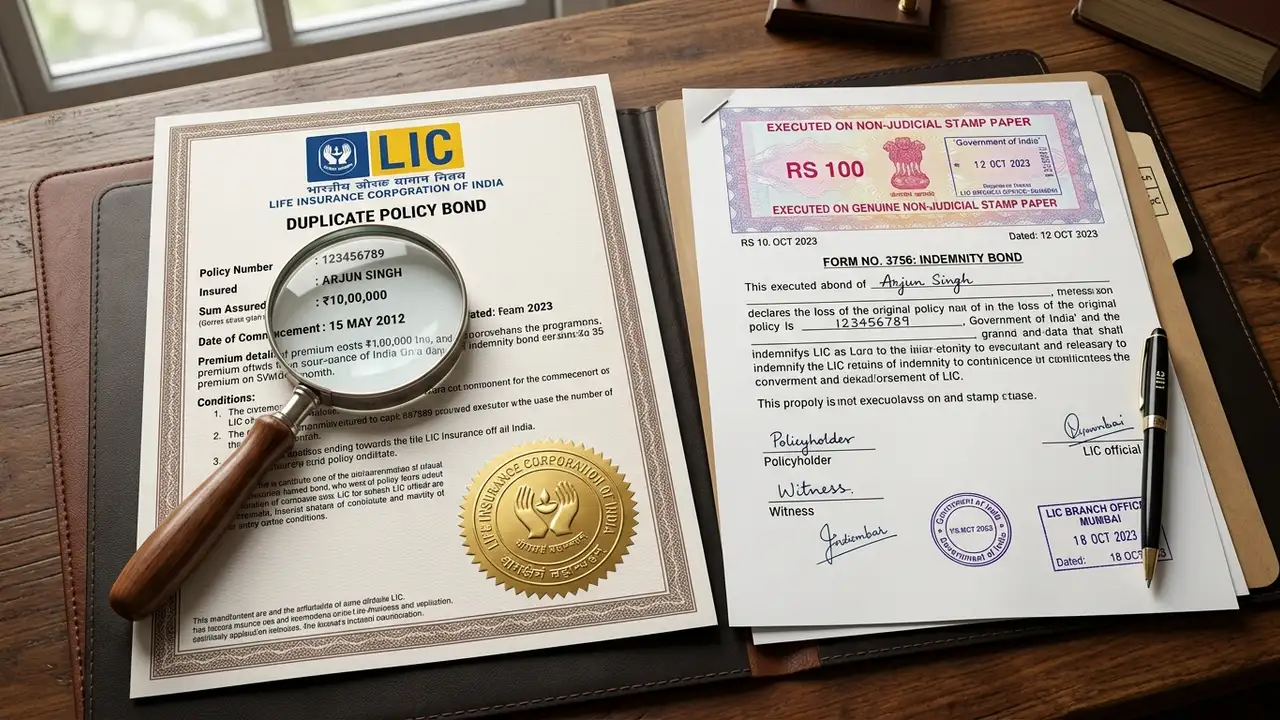
- Custody of Original Policy Bond: The physical original Policy Document (Bond) must be deposited with LIC. The corporation retains physical possession of the bond in its vault as collateral until the loan principal and all accrued interest are repaid in full.
- Nomination Suspension: By statutory operation of law under Section 39 of the Insurance Act, any existing nominee designation on the policy is automatically superseded and suspended in favour of the Corporation to the extent of the Corporation's debt. If the life assured passes away while the loan is outstanding, LIC satisfies its debt first and releases any surplus balance to the designated beneficiary or legal heirs.
- Re-assignment upon Clearance: The moment you repay the outstanding principal and interest balance, LIC executes a formal Deed of Re-assignment on the policy bond, restoring full legal ownership and reinstating the original nominee designation.
Because the loan is 100% secured by accumulated cash surrender values held directly within LIC's actuarial reserves, your CIBIL or Experian credit score is completely irrelevant. There is no credit bureau verification, no income proof requirement (no salary slips or ITR verification), and no inquiry imprint on your credit report.
2. Eligibility Rules & Eligible Policy Plans
Not every policy issued by LIC is eligible for loan advances. Eligibility is determined strictly by whether the specific insurance plan accumulates a guaranteed or special cash surrender value under IRDAI guidelines.
2.1 Minimum Premium Paying Period
Under the revised IRDAI (Non-Linked Insurance Products) Regulations, a policy contract acquires a loan eligibility milestone only after acquiring a surrender value:
- Policies with Premium Paying Term (PPT) of 10 Years or More: Must have completed payment of continuous premiums for at least two consecutive full years (for policies issued on or after January 1, 2020) or three years (for older policies).
- Policies with Premium Paying Term (PPT) under 10 Years: Must have completed payment of continuous premiums for at least two consecutive full years.
- Single Premium Plans: Loan facility becomes accessible after the completion of one full policy year (or after 3 months under specific single premium non-participating formulations).
2.2 Eligible vs Ineligible Policy Categories
| Plan Category | Representative LIC Plans | Loan Status | Actuarial Rationale |
|---|---|---|---|
| Endowment Assurance | New Endowment (914), Jeevan Labh (936), Jeevan Anand (915) | Eligible | Accumulates robust guaranteed cash surrender value and vested simple reversionary bonuses. |
| Money Back Plans | 20-Year Money Back (920), 25-Year Money Back (921), Bima Ratna | Eligible | Eligible; loan amount is adjusted dynamically as survival benefit milestones are paid out. |
| Whole Life Plans | Jeevan Umang (945), Jeevan Utsav (871) | Eligible | High accumulation of surrender equity over long horizons; guaranteed annual payouts continue. |
| Pure Term Insurance | Tech Term (854), Yuva Term (875), Saral Jeevan Bima (859) | Ineligible | Pure risk protection contracts that accumulate zero cash surrender value. |
| Unit Linked Plans (ULIPs) | SIIP (852), Nivesh Plus (849) | Ineligible | IRDAI ULIP regulations prohibit policy loans due to market volatility of fund units. |
| Child Plans (Minor Assured) | Amritbaal (874), Tarun (934) | Conditional | Loan permitted only for documented educational or medical benefit of the minor life assured. |
3. Maximum Loan Calculation: 90% vs 85% LTV Limits
The maximum loan quantum you can borrow is governed strictly by the Loan-to-Value (LTV) ratio applied to the policy's official Surrender Value on the application date. LIC applies a two-tiered statutory ceiling:
If all due premiums are paid to date and the policy is fully in-force, LIC advances up to 90% of the Net Surrender Value (inclusive of vested reversionary and interim bonuses).
If premium payments have ceased after acquiring surrender value and the policy has shifted to Paid-Up status, the maximum borrowing ceiling is capped at 85% of the Net Surrender Value.
The term Net Surrender Value means the gross surrender value computed by the LIC actuarial valuation engine minus any unpaid due premiums, interest penalties, or previous unliquidated loan balances.
4. Current 2026 Interest Rate Structure & Half-Yearly Compounding
LIC policy loan interest rates are established periodically by the Corporation's Investment Committee based on prevailing 10-year Government of India benchmark bond yields and RBI repo rate trajectories.
4.1 Governing Interest Rate Rules
- Prevailing Interest Rate (2025-2026): 9.50% per annum payable half-yearly (for policies issued under current tariff schedules). For certain older contracts, historical rates ranging from 9.0% to 10.0% apply depending on the policy endorsement schedule.
- Calculation Frequency: Interest accrues continuously and is compounded half-yearly on the policy anniversary date and exactly six months thereafter.
- Mandatory Minimum Interest Period: Under LIC Operational Standing Order Circular Ref: Actl/2085/4, the minimum interest charged on any policy loan is for a period of six months. If you borrow funds and repay the entire balance within 20 days, you are still legally obligated to pay 6 full months of interest.
- Grace Period for Loan Interest: A 30-day grace period is provided for the payment of half-yearly interest notices. If interest is not paid within this grace period, it is capitalized into the principal debt.
5. Comprehensive Case Study: Step-by-Step Loan Math
To observe how the loan eligibility, interest compounding, and repayment mechanisms function in practice, consider the following real-world case study of an Indian policyholder:
Case Study Profile: Mr. Rajesh Sharma (LIC New Endowment Plan 914)
Step 1: Surrender Value Computation (Special Surrender Value)
• Paid-Up Sum Assured = (5 / 20) × ₹10,00,000 = ₹2,50,000
• Total Vested Bonuses = 5 × (1,000 × 42) = ₹2,10,000
• Total Paid-Up Value = ₹2,50,000 + ₹2,10,000 = ₹4,60,000
• SSV Factor (5th Year Duration) = 44.50%
• Net Surrender Value (SV) = ₹4,60,000 × 44.50% = ₹2,04,700
Step 2: Maximum Eligible Loan Calculation (90% LTV)
• Max Loan Eligible = 90% × ₹2,04,700 = ₹1,84,230
• Rounded to Nearest Hundred (LIC Standard Convention) = ₹1,84,200
Step 3: Half-Yearly Interest Liability (9.50% p.a.)
• Half-Yearly Interest = ₹1,84,200 × (9.50% / 2) = ₹1,84,200 × 4.75% = ₹8,750
Financial Outcome for Policyholder:
Mr. Sharma receives ₹1,84,200 directly in his bank account via NEFT within 48 hours. To service the loan, he only needs to pay ₹8,750 every six months. His underlying life insurance coverage of ₹10,00,000 remains 100% active and continues accumulating annual bonuses uninterrupted.
6. Line-by-Line Guide to Form 5196 (Loan Application)
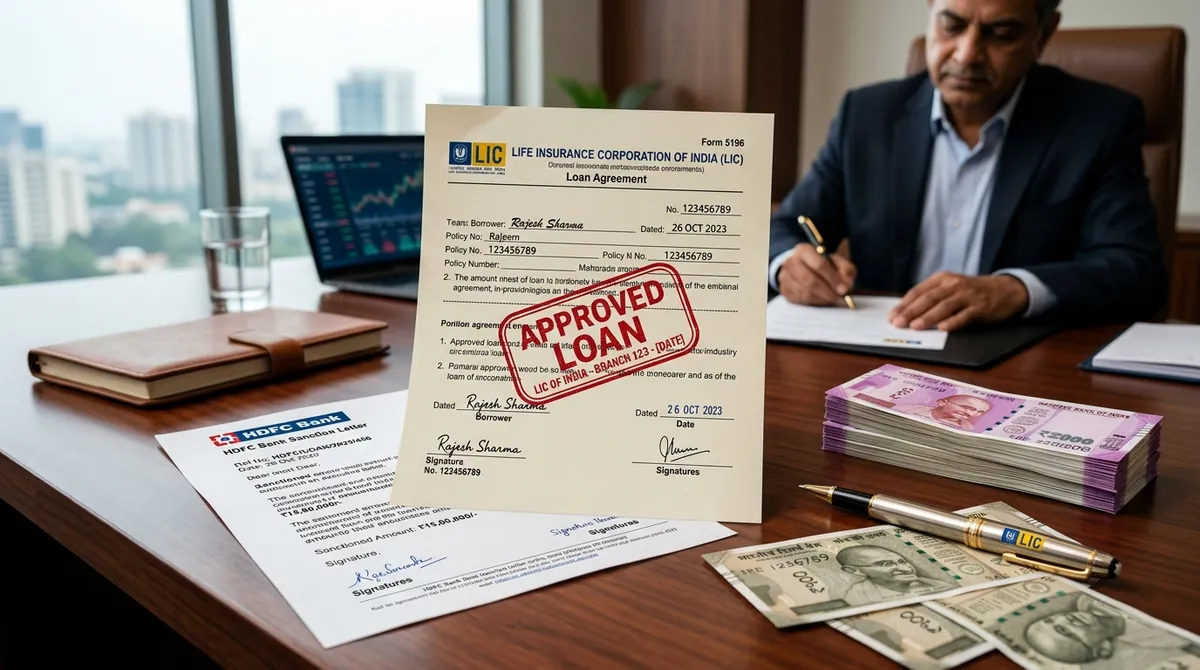
For policyholders choosing the branch counter submission route, obtaining a loan requires executing LIC Form No. 5196 (Application for Loan on Policy Bond) accompanied by the statutory mortgage deed. Completing this document accurately prevents administrative rejections.
Policyholder & Contract Identifiers
Fill in the 9-digit LIC Policy Number, exact name as registered on the policy bond, current residential address, verified mobile phone number, and PAN card number. Ensure the address matches your KYC documents.
Loan Amount Requested
You can either write an exact rupee amount (e.g., "₹1,50,000") or write "Maximum Eligible Loan Amount". Selecting the maximum option instructs the branch actuarial terminal to disburse the full 90% SV ceiling.
Absolute Assignment Endorsement (Page 2)
This is the legal deed. The policyholder must sign across the printed endorsement clause stating: "In consideration of the sum of Rupees... I hereby assign all my right, title and interest in the within-written policy to the Life Insurance Corporation of India..."
Revenue Stamp Execution
Under the Indian Stamp Act, the assignment clause must bear a ₹1.00 (One Rupee) Revenue Stamp affixed to the document. The borrower must execute their signature diagonally across the revenue stamp so that part of the signature lies on the stamp and part on the paper.
Bank Mandate & NEFT Form
Attach a personalized cancelled cheque showing your name, bank account number, and IFSC code. If the cheque leaf does not have your pre-printed name, include a self-attested copy of your bank passbook first page showing recent transactions.
Mandatory Physical Document Dossier for Branch Submission:
- • Original Policy Document (Bond): The original physical bond certificate is strictly required.
- • Duly Executed Form 5196: Signed across the ₹1 revenue stamp.
- • Personalized Cancelled Cheque: For direct NEFT credit into your savings bank account.
- • Self-Attested KYC: Copy of Aadhaar card and PAN card.
- • Zero Processing Fees: LIC charges ₹0 processing fee for policy loans; do not pay any cash or broker fees.
7. Step-by-Step Online Portal Application (Premier Services)
Registered policyholders who have activated Premier Services on the official LIC Customer Portal can complete the entire loan application digitally without ever stepping foot inside a branch office:
Log in to LIC Customer Portal
Visit the official portal at ebiz.licindia.in/b2c. Log in using your User ID/Mobile/Email, Password, and Date of Birth. Complete two-factor authentication via SMS OTP.
Navigate to Premier Services → Customer Loan
From the left navigation dashboard, click on "Premier Services" and select "Customer Loan".
Select Policy & Review Loan Quotation
Select your eligible policy number from the dropdown. The system automatically fetches your current Surrender Value, displays the maximum allowable loan ceiling (90% or 85%), and shows the applicable half-yearly interest rate.
Enter Desired Quantum & Confirm Bank Mandate
Type your desired loan amount (up to the maximum eligible ceiling). Confirm the verified bank account details already registered under your LIC profile.
Execute Aadhaar e-Sign & Submit
The system generates a digital Loan Agreement. Read the terms, check the declaration box, and click "Proceed to e-Sign". Enter your 12-digit Aadhaar number and authenticate with the OTP.
Direct NEFT Disbursal
Upon digital underwriting clearance, the loan proceeds are credited directly into your verified bank account via NEFT within 48 to 72 bank working hours.
8. Repayment Mechanics: Can You Pay Only Interest?
The single greatest financial advantage of an LIC policy loan is its extraordinary repayment flexibility. Unlike commercial bank loans that impose rigid monthly Equated Monthly Installments (EMIs) with harsh penalty charges on defaults, LIC offers complete sovereign flexibility:
Option A: The Interest-Only Servicing Strategy (Recommended)
You are never legally forced to repay the principal amount during the active policy term. You can choose to pay only the half-yearly interest notices as they fall due (payable online through the LIC portal, UPI, or Net Banking). When the policy matures, LIC automatically deducts the original principal balance from the final maturity payout and transfers the entire remaining maturity bonus to your bank account.
Option B: Flexible Part-Prepayments
Whenever you have surplus cash, you can deposit partial principal repayments (minimum ₹1,000 or multiples thereof) at any branch cash counter or online through the customer portal. The moment a partial payment is credited, your subsequent half-yearly interest calculation is immediately recalculated downward on the reduced outstanding balance. There are zero prepayment or foreclosure penalty charges.
Option C: Full Lump-Sum Clearance
You can pay off the entire outstanding loan and accrued interest at any time (subject to the 6-month minimum interest clause). Once fully cleared, you can submit an application to your home branch to collect your original physical policy bond with the formal endorsement of re-assignment.
9. The Critical Foreclosure Trap in Paid-Up Policies
While in-force policies enjoy complete safety, policyholders holding Paid-Up Policies must beware of the dangerous Foreclosure Trap.
If a policy is in Paid-Up status (meaning future premium payments have stopped) and the policyholder fails to pay the half-yearly loan interest, the unpaid interest compounds and gets capitalized into the principal debt. If at any time:
Total Outstanding Debt (Principal + Unpaid Interest) ≥ Total Surrender Value
LIC serves a 30-day statutory notice. If the deficit is not paid, the Corporation automatically forecloses and terminates the policy. The surrender value is seized to liquidate the debt, the policy is permanently cancelled, and all life insurance protection is forever lost.
In-force Policy Immunity: Note that for fully in-force policies where regular annual premiums are continuously paid, LIC does not enforce automatic foreclosure because the surrender value continues to grow each year at a pace faster than the compounding loan interest. However, allowing interest to accumulate significantly reduces your eventual maturity payout.
10. Impact on Death & Maturity Claim Settlements
What happens if an unexpected event occurs while a loan balance is still active on your policy? The settlement mechanism is automatic, equitable, and transparent under IRDAI claims settlement guidelines:
Scenario 1: Policyholder Passes Away (Death Claim)
If the life assured dies while a policy loan is outstanding:
- The full Sum Assured on Death plus all accrued simple reversionary bonuses and final additional bonuses (FAB) are calculated by the claims department.
- LIC actuarially calculates the exact outstanding loan principal plus interest accrued up to the date of death.
- This outstanding debt is deducted from the gross claim amount.
- The entire remaining balance is paid directly to the registered nominee. Life insurance protection was never compromised.
Scenario 2: Policy Reaches Full Maturity
When the policy term finishes:
- The full contractual maturity amount (Basic Sum Assured + Total Accrued Bonuses) is credited.
- The outstanding loan principal and any unpaid interest are netted off against the gross proceeds.
- The net surplus amount is transferred directly to the policyholder's bank account via NEFT.
11. Comparative Analysis: LIC Loan vs Personal Loan vs Gold Loan
Evaluating alternative short-to-medium term debt instruments reveals why an LIC policy loan is consistently the most financially prudent choice for emergency liquidity:
| Feature | Loan Against LIC Policy | Bank Personal Loan | Gold Loan |
|---|---|---|---|
| Interest Rate (p.a.) | 9.0% - 9.50% (Fixed) | 11.50% - 18.00% (Variable) | 9.50% - 15.00% |
| Processing Fee | ₹0 (Zero) | 1.0% to 3.0% + GST | 0.5% to 1.5% + Appraiser fee |
| CIBIL / Credit Check | None (0% impact) | Mandatory (Requires 750+) | Minimal / Informal |
| Income Proof Required | None (No ITR/Salary slip) | Mandatory 3-yr ITR / Form 16 | None |
| EMI Repayment Pressure | Zero (Pay only interest) | Strict Monthly EMI penalty | Monthly / Bullet repayment |
| Prepayment Penalty | ₹0 (Zero charges) | 2% to 5% foreclosure fees | Usually Nil to 2% |
| Collateral Risk | Paper bond (Zero physical risk) | Unsecured (Legal recovery) | Physical gold kept in locker |