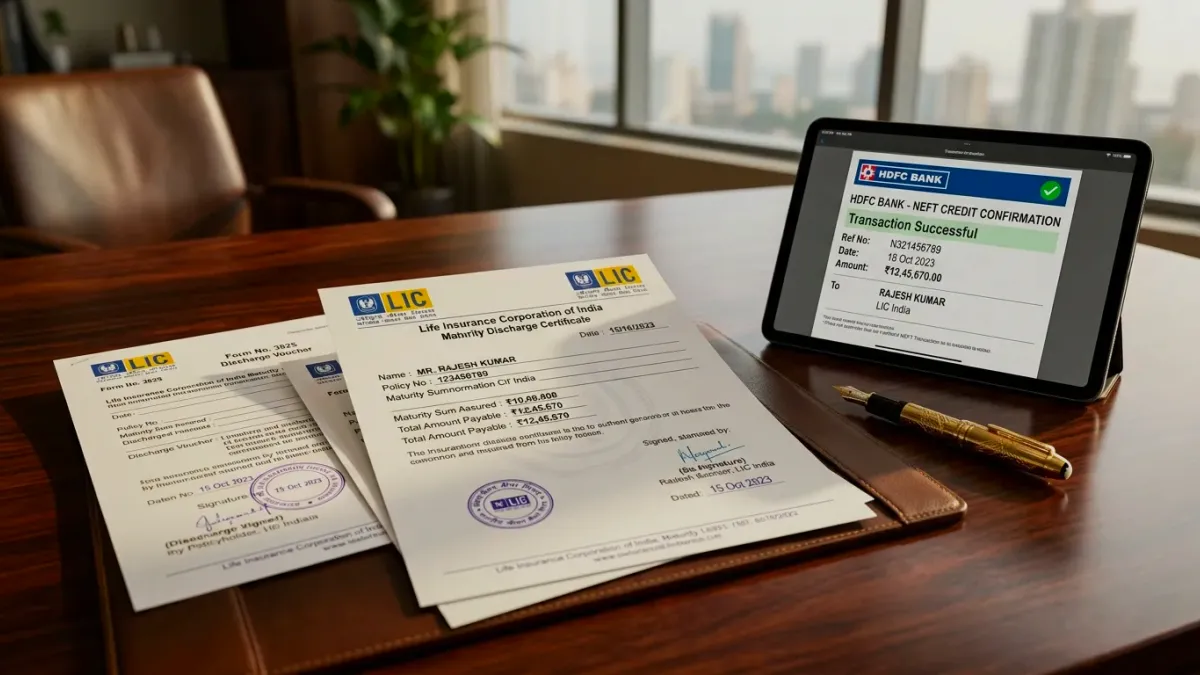
Reaching the maturity date of a long-term Life Insurance Corporation of India (LIC) policy marks the triumphant fulfillment of a 15, 20, or 25-year financial journey. After decades of disciplined premium payments, you are entitled to receive your contractual maturity corpus—combining your guaranteed basic sum assured with decades of compounded annual bonuses and loyalty additions. However, navigating the bureaucratic claim discharge process often causes unexpected anxiety for policyholders.
This exhaustive, actuarially verified guide details the exact legal procedure to claim your LIC maturity proceeds in 2026. From deciphering the Form 3825 discharge voucher and executing revenue stamps to resolving lost policy bonds and understanding Section 194DA tax withholding, this manual provides everything required to guarantee an on-time NEFT bank credit.
1. Regulatory Mandate & IRDAI Claim Timelines
Under the Insurance Regulatory and Development Authority of India (Protection of Policyholders' Interests) Regulations, maturity claims are classified as predetermined contractual obligations. Because the date of maturity is fixed at policy inception, insurance companies are held to rigid statutory performance standards:
- Mandatory Advance Intimation: LIC is required to issue a formal Maturity Claim Intimation Letter along with the discharge voucher to the policyholder's registered address at least two months prior to the date of maturity.
- Zero-Day Settlement Rule: Where the policyholder completes and submits all required discharge papers at least 30 days before the due date, LIC is legally mandated to disburse the maturity proceeds on or before the exact date of maturity.
- Statutory Penal Interest for Delay: If LIC delays payment beyond the due date despite receiving all complete claim papers, the Corporation is statutorily liable to pay penal interest at the prevailing Bank Rate plus 2.0% per annum from the due date until the date of actual bank realization.
In a maturity claim, beneficial ownership belongs exclusively to the living Life Assured. Unlike a death claim, the nominee has zero legal standing to claim, sign, or receive maturity proceeds. The discharge voucher must be signed by the policyholder, and proceeds can only be credited to a verified bank account in the primary policyholder's name.
2. How Maturity Payout is Computed (Sum Assured, Bonuses & FAB)
The total maturity payout for a traditional participating endowment policy (such as Jeevan Labh Plan 936, New Endowment Plan 914, or Jeevan Anand Plan 915) is determined through an actuarial tripartite formula:
LIC Maturity Benefit Formula:
Total Maturity Payout = Basic Sum Assured + Total Vested Simple Reversionary Bonuses + Final Additional Bonus (FAB)
Where bonuses are calculated on the Basic Sum Assured per thousand rupees, based on annual valuation surplus declarations audited by the Appointed Actuary.
Component 1: Basic Sum Assured (BSA)
The contractual guaranteed capital sum printed on the face of your policy bond. This is 100% guaranteed regardless of market fluctuations or LIC's investment returns.
Component 2: Simple Reversionary Bonuses (SRB)
Declared annually by LIC at the close of every financial year based on actuarial surplus. Once declared, these bonuses vest irrevocably in the policy and cannot be clawed back. For 20-year plans, bonus rates historically range from ₹40 to ₹48 per thousand Sum Assured per year.
Component 3: Final Additional Bonus (FAB)
A special terminal loyalty payout awarded exclusively to policies that run for a minimum duration of 15 years. FAB rewards long-term policyholders and scales exponentially for 20 to 30-year policy tenures, often contributing between ₹50 and ₹550 per thousand Sum Assured to the final cheque.
Authentic Numerical Case Study: Jeevan Labh (Plan 936)
• Policyholder: Mr. Suresh Menon
• Basic Sum Assured: ₹10,00,000 | Policy Term: 21 Years (PPT: 15 Years)
• Accumulated Reversionary Bonuses (21 years @ ₹46/thousand avg): 21 × ₹46,000 = ₹9,66,000
• Final Additional Bonus (FAB @ ₹100/thousand for 21-yr term): 1,000 × ₹100 = ₹1,00,000
• Gross Maturity Payout: ₹10,00,000 + ₹9,66,000 + ₹1,00,000 = ₹20,66,000.
Mr. Menon receives more than double his initial sum assured tax-free into his bank account.
3. Pre-Maturity Intimation Letter & Dispatch Schedule
Approximately 60 to 90 days before your policy matures, LIC's central operations system triggers an automated Maturity Claim Notice (Form 3825 / Intimation Slip) sent via registered post or Speed Post to your registered postal address.
The intimation packet contains:
- The exact contractual Date of Maturity.
- A detailed breakdown of the Basic Sum Assured and estimated interim bonuses.
- Pre-printed Form No. 3825 (Discharge Voucher) with policyholder and policy identifiers already filled.
- A standard NEFT Mandate Form to register your bank account details.
Non-receipt of the postal notice does NOT delay your maturity claim. If your address has changed or the letter was lost in transit, simply download a blank Form No. 3825 from the official LIC portal (or pick one up at any LIC branch cash counter) and submit it manually with your policy bond.
4. Line-by-Line Guide to Form 3825 (Maturity Discharge Voucher)
LIC Form No. 3825 (Discharge Voucher for Maturity Claim) is the primary legal release deed. Completing this form without clerical errors ensures rapid processing:
Policy & Life Assured Particulars
Confirm the 9-digit Policy Number, Full Name of the Life Assured (in capital letters matching the policy bond), current residential address, verified mobile number, and PAN card number.
Maturity Settlement Amount Details
Verify the gross claim figures printed by the branch. If filling a blank form, write the Basic Sum Assured and state "Together with all vested bonuses and FAB as per Corporation records".
Legal Discharge Clause & Revenue Stamp
Under the Indian Stamp Act, you must affix a ₹1.00 (One Rupee) Revenue Stamp in the designated box on the bottom right. The policyholder must sign diagonally across the revenue stamp so that half the signature rests on the stamp and half on the paper.
Witness Attestation (Crucial Requirement)
The signature of the policyholder must be witnessed by a person of competent legal standing: a licensed LIC Agent, Development Officer, Branch Manager, Gazetted Officer, School Headmaster, or Nationalized Bank Manager. The witness must sign, record their full name, address, and stamp.
5. Mandatory Physical Document Dossier Checklist
When submitting your maturity discharge packet to your home servicing branch, compile the following complete document dossier:
Original LIC Policy Document (Bond)
The physical stamped bond issued when the policy was accepted. Mandatory for full maturity discharge.
Duly Executed Form No. 3825
Signed across the ₹1 revenue stamp and attested by an authorized witness.
NEFT Mandate Form & Pre-Printed Cancelled Cheque
Personalized cancelled cheque leaf displaying your name, bank account number, and IFSC code. If the cheque is unpersonalized, attach a self-attested bank passbook first page copy.
Self-Attested KYC Documents (PAN & Aadhaar)
Mandatory under Anti-Money Laundering (AML) directives. PAN card submission is compulsory to prevent punitive 20% TDS under Section 206AA.
6. Money-Back Survival Benefits: Automated Settlement Rules
Policyholders holding traditional Money-Back Plans (such as 20-Year Money Back Plan 920, 25-Year Money Back Plan 921, or Bima Ratna Plan 864) receive periodic survival benefits throughout the policy term.
| Feature | Full Maturity Claim | Periodic Money-Back Survival Benefit |
|---|---|---|
| Original Policy Bond Required? | Yes (Must be deposited & cancelled) | No (Retained by policyholder) |
| Discharge Form 3825 Required? | Yes (Form 3825 mandatory) | No (Form 5180 only if NEFT unlinked) |
| Settlement Mode | NEFT on Maturity Date | Automated Direct Credit via NEFT |
| Life Cover Impact | Policy concludes permanently | 100% Life cover continues unaffected |
Automated Payout Condition: As long as your bank account is already registered under your LIC policy profile (via NEFT mandate), LIC automatically initiates survival benefit transfers on the exact survival anniversary without requiring branch visits.
7. Step-by-Step Submission Procedure (Branch vs Online Tracking)
While the submission of the physical policy bond must take place at an LIC branch counter, the claim progression can be managed and tracked seamlessly:
Submit Dossier to Servicing Branch
Visit the Claims & Policy Servicing Counter of your home servicing branch (or any convenient branch under all-India servicing rules, allowing 5 extra days for inter-branch transfer). Obtain an official stamped acknowledgment slip.
Actuarial Audit & Signature Verification
The branch claims officer verifies your signature against the original proposal form micro-film docket and audits premium records to confirm all dues are cleared.
Track Claim Status Online via Customer Portal
Log in to ebiz.licindia.in, navigate to "Online Services" → "Claim Status", and enter your policy number to view real-time underwriting milestones.
Automated NEFT Credit & Confirmation SMS
On the maturity date, LIC's central disbursement engine releases the funds via NEFT. You receive an automated SMS with the UTR reference number.
8. Handling Complex Scenarios: Lost Bond, Active Loan & Sign Mismatch
Scenario A: What If the Original Policy Bond is Lost or Destroyed?
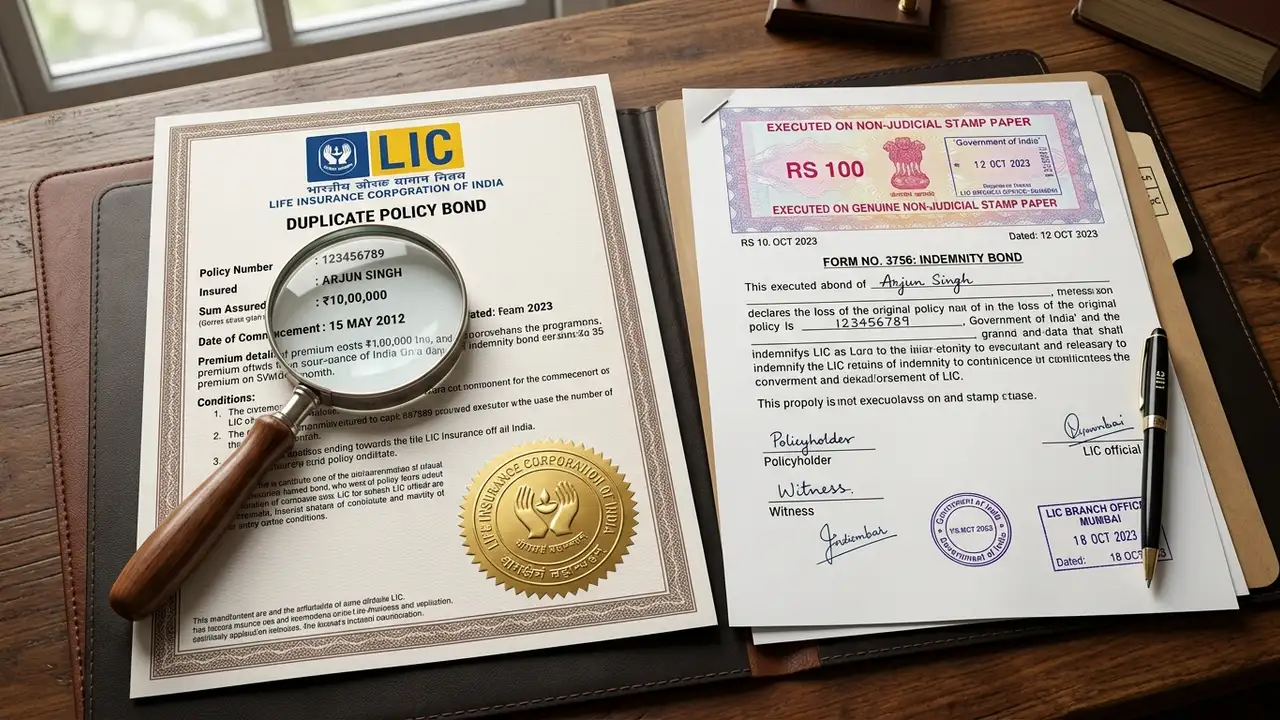
If you cannot locate your physical policy bond certificate, you are NOT required to obtain a costly duplicate policy bond. Instead, LIC permits executing Form No. 3756 (Indemnity Bond for Lost Policy Bond at Settlement):
- Execute Form 3756 on non-judicial stamp paper (stamp duty values range from ₹100 to ₹500 depending on state stamp regulations).
- Provide an affidavit detailing the circumstances of the loss (e.g. lost during home relocation).
- Get the indemnity bond signed by a solvent surety/guarantor.
- LIC approves the claim without re-issuing a physical bond, disbursing your full maturity proceeds.
Scenario B: What If There is an Outstanding Policy Loan?
If you took a loan against your LIC policy and have not repaid the principal or pending interest:
- LIC's actuarial terminal calculates the exact loan principal and interest accrued up to the maturity date.
- This total debt is automatically deducted from your gross maturity proceeds.
- The net surplus amount is credited directly to your bank account, and the loan is formally extinguished.
Scenario C: What If There is a Signature Mismatch?
If your current signature differs from the specimen signature executed 20 years ago on the original proposal form:
- Submit Form No. 3251 (Letter of Indemnity for Change of Signature).
- Get your signature formally attested by your commercial bank branch manager using their official bank stamp.
- Attach self-attested KYC documents (Passport, PAN card, or Aadhaar) displaying your modern signature.
9. Taxability & TDS Deductions under Section 194DA / 10(10D)
Navigating the tax implications on maturity proceeds depends entirely on when your policy was purchased and the annual premium quantum:
| Policy Inception Date | Qualifying Criterion | Section 10(10D) Status | TDS Withholding (Section 194DA) |
|---|---|---|---|
| Policies Issued Prior to April 1, 2023 | Annual premium ≤ 10% of Basic Sum Assured | 100% Tax-Free (No Limit) | 0% (Nil TDS) |
| Policies Issued On or After April 1, 2023 | Aggregate annual premium ≤ ₹5,00,000 | 100% Tax-Free | 0% (Nil TDS) |
| Policies Issued On or After April 1, 2023 | Aggregate annual premium > ₹5,00,000 | Taxable as Other Sources | 5% TDS on Net Profit (if profit > ₹1,00,000) |
If your maturity payout is subject to Section 194DA TDS but your total estimated taxable income for the financial year is below the basic tax exemption limit (₹2,50,000 / ₹3,00,000 in old regime or ₹3,00,000 in new regime), you can submit Form 15G (or Form 15H for senior citizens aged 60+) along with Form 3825 to receive your full payout with 0% TDS deduction.
10. Lump Sum vs Staggered Installment Settlement Options
Instead of collecting a large lump-sum payout on maturity, policyholders planning for retirement cash flows can opt for LIC's Settlement Option:
The entire maturity corpus (Sum Assured + Bonuses + FAB) is disbursed into your bank account via NEFT on the maturity date. Ideal for purchasing real estate, clearing home loans, or investing in mutual funds.
The maturity corpus is converted into structured monthly, quarterly, or annual pension-like installments over 5, 10, or 15 years. The unpaid balance continues to earn annual interest compounded half-yearly.
Content validated against IRDAI (Protection of Policyholders' Interests) Regulations, Section 194DA of Income Tax Act 1961, and Life Insurance Corporation of India Master Claims Operations Circulars (2025-2026).