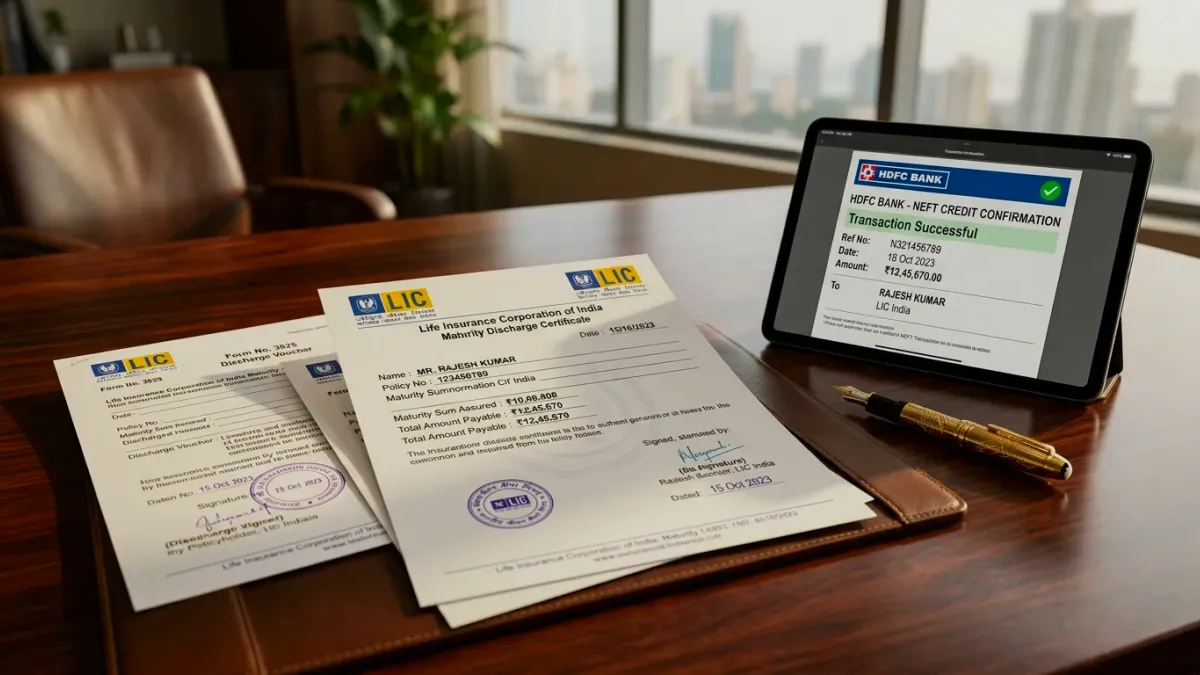
With over 25 crore active individual policies and sovereign backing under Section 37 of the Life Insurance Corporation Act, 1956, the Life Insurance Corporation of India (LIC) commands unprecedented public trust across the Indian subcontinent. Tragically, this sovereign trust has made LIC policyholders the prime targets of sophisticated, syndicated cybercrime rings and illegal boiler-room call centers. Every day, thousands of Indian citizens receive deceptive telephone calls, WhatsApp audios, and SMS alerts from impostors posing as senior officials from the "IRDAI Grievance Directorate", "LIC Central Office Mumbai", or "Ministry of Finance Insurance Welfare Cell".
These fraudsters promise lucrative, non-existent "unclaimed policy bonuses", threaten the immediate forfeiture of accumulated life savings, or manipulate policyholders into surrendering seasoned, high-yielding traditional policies in exchange for toxic financial products. Navigating this treacherous landscape requires actionable legal awareness, forensic document literacy, and rigorous banking hygiene. This comprehensive operational manual provides the definitive framework to verify physical policy documents, authenticate intermediary credentials on regulatory portals, identify red flags, and deploy emergency cybercrime reporting mechanisms.
1. The Epidemic of Insurance Scams: Fake IRDAI & LIC Call Centers in India
Insurance fraud in India has evolved from isolated mis-selling by rogue field agents into organized, syndicated cybercrime enterprises. Clandestine boiler-room call centers operating in suburban cyber hubs—including Noida, Gurgaon, Jamtara, Mewat, Kolkata, and Thane—employ hundreds of tele-callers equipped with persuasive scripts, forged letterheads, spoofed caller IDs, and illicit policyholder databases.
According to public advisories released by the Insurance Regulatory and Development Authority of India (IRDAI) and parliamentary disclosures, spurious phone calls represent the single largest category of unfair business practices reported by consumers. Fraudulent syndicates procure compromised data dumps originating from leaked third-party aggregators, rogue telemarketing vendors, or compromised regional agency registers. These data caches contain confidential policy records: policyholder names, residential addresses, 9-digit policy numbers, plan types, annual premium commitments, and nomination records.
Fraudsters rarely call as ordinary salespeople; they weaponize institutional authority to disarm skepticism. Common aliases deployed by criminal callers include:
- "IRDAI Grievance Resolution & Bonus Disbursement Officer": Fabricating an imaginary regulatory department supposedly releasing withheld insurance funds.
- "LIC Central Office Audit Cell (Yogakshema, Mumbai)": Posing as national compliance auditors investigating regional branch negligence.
- "Ministry of Finance Special Ombudsman Committee": Falsely citing Prime Minister relief packages or parliamentary directives.
- "Senior Claims Settlement Executive": Claiming an urgent deadline requires immediate bank account verification or fee deposition.
The Statutory Clarification on IRDAI: Established under the Insurance Regulatory and Development Authority Act, 1999, IRDAI operates purely as an autonomous statutory supervisor governing insurance carriers, corporate brokers, and licensed intermediaries. IRDAI is strictly a regulatory entity—it does not sell insurance policies, does not invest public funds, does not announce or disburse bonuses, does not adjudicate financial claims directly with individual policyholders, and never initiates telephone calls or digital communications demanding funds from the public. Any voice on a telephone call claiming to represent "IRDAI's Bonus Office" is, by statutory definition, an impersonator engaged in criminal conspiracy.
2. Modus Operandi of Common Spurious Calls & Phishing Traps
Criminal syndicates exploit human psychology through three distinct operational blueprints: financial greed (promising unexpected wealth), bureaucratic terror (threatening asset forfeiture), and regulatory confusion (exploiting ignorance of actuarial bonus allocation). Understanding these specific scripts enables policyholders to detect traps within thirty seconds of conversation.
A. The "Unclaimed Bonus / Lapsed Money Release" Scam
Advance Fee FraudThe Psychological Hook: The caller contacts a policyholder who holds an active policy or allowed a policy to lapse several years ago. Quoting the exact policy number and home branch, the scammer announces: "Sir/Madam, an internal forensic audit reveals that your policy has an accumulated unclaimed reversionary bonus and loyalty surplus of ₹3,85,000 lying dormant in the central reserve account. Under latest Finance Ministry gazette notifications, this amount will permanently lapse to the Investor Education & Protection Fund (IEPF) within 72 hours unless encashed."
The Trap Mechanism: To release this windfall, the caller insists that the policyholder must remit an upfront "statutory file release fee", "GST clearance voucher", or "stamp duty processing charge" of ₹25,000 to ₹65,000.
Payment Diversion: The victim is instructed to transfer the funds via UPI (Google Pay, PhonePe, Paytm) to a personalized Virtual Payment Address (VPA) or deposit money into a private current account under names like "Policy Claims Resolution Bureau" or "National Insurance Nodal Hub"—which are actually rented mule accounts operated by syndicate handlers.
The Endless Extortion Loop: Once the initial deposit is transferred, the victim never receives the bonus. Instead, a "Senior Audit Officer" calls back demanding a secondary fee of ₹40,000 for "income tax clearance" or "TDS pre-payment under Section 194DA". The extortion continues until the victim is completely drained or realizes the fraud.
B. The "Policy Exchange / High-Return Conversion" Trap
Policy Churning & ForfeitureThe Psychological Hook: The fraudster targets policyholders holding long-term participating traditional endowments (such as Jeevan Anand, Jeevan Labh, or New Endowment Plan). The caller states: "Your current traditional LIC plan is an obsolete, low-yielding product providing only a 4.5% internal rate of return. Under the Special Government Portfolio Modernization Directive, LIC is offering an exclusive porting window to convert your old policy into a new guaranteed 14% to 16% sovereign growth plan with triple life cover."
The Actuarial Destruction: The scammer convinces the policyholder to visit the branch, execute Form No. 5074 (Surrender Deed), and surrender their seasoned 8-to-12-year-old policy. Surrendering early results in massive capital destruction, liquidating 30% to 50% of nominal asset value and completely forfeiting future terminal and final additional bonuses (FAB).
The Diversionary Theft: Once the surrender proceeds hit the policyholder's bank account, the fraudster (posing as a helpful financial advisor) immediately gets the victim to sign an application form and issue a fresh cheque for a high-ticket Unit Linked Insurance Plan (ULIP) or deferred annuity issued by a private insurer. The rogue telemarketer pockets a 30% to 40% first-year agent commission, leaving the policyholder stripped of guaranteed benefits, sovereign security, and years of compound bonus accumulation.
C. The "Government Subsidized Bonus" Phishing Scam
Digital Phishing & Account TakeoverThe Psychological Hook: The victim receives a high-urgency SMS or WhatsApp communication reading: "URGENT: Government of India has approved COVID/Economic Relief Bonus of ₹1,42,800 on LIC Policy No. XXXXX4589. Claim expires at 23:59 tonight. Verify KYC immediately at: licindia-bonus-claim.org/verify".
The Spoofed Portal Interface: Clicking the link opens an identical typographical clone of the official LIC Customer Portal, complete with LIC logos, Ashoka emblems, and SSL padlock icons.
Credential Harvesting: The web form requests the policyholder's registered mobile number, Date of Birth, Net Banking User ID, Login Password, Debit Card Number, Expiry Date, and 3-digit CVV under the pretext of "mandatory e-mandate bank validation".
Real-Time Session Hijacking: Backend automated scripts capture these credentials. The fraudsters initiate unauthorized instant IMPS fund transfers or high-value gift card purchases. An automated call or live scammer calls the victim: "Please read out the 6-digit verification code sent by your bank to credit your bonus". The moment the victim discloses the OTP, their entire bank savings balance is drained within seconds.
| Scam Category | The Fraudulent Bait | The Demanded Action | Actual Financial Impact |
|---|---|---|---|
| Unclaimed Bonus Release | ₹2 to ₹8 Lakhs dormant bonus on old/lapsed policy | Pay advance processing fee or GST via UPI/IMPS | Immediate direct loss of advance fees (₹25k–₹1.5L) |
| Policy Exchange / Modernization | 14%–18% guaranteed return in "new government scheme" | Surrender traditional LIC policy and sign new private proposal | Catastrophic capital loss; forfeiture of guaranteed sum assured |
| Subsidized Bonus Phishing | Government relief subsidy or special bonus dividend | Click phishing URL and share banking credentials / OTP | Total bank account compromise; unauthorized electronic drainage |
| Foreclosure Threat | Notice claiming policy will be cancelled due to missing KYC | Transfer penalty fee to "unblock" policy account | Extortion of recurrent fees under administrative intimidation |
3. The Golden Actuarial Rule: How LIC Bonus Allocation Actually Works
To make yourself permanently immune to spurious bonus calls, you must master the fundamental mathematical reality of how the Life Insurance Corporation of India calculates, allocates, and disburses policyholder bonuses. Once you understand the actuarial mechanics of a participating life insurance contract, every single bonus call exposes itself as an absurd impossibility.
3.1 The Statutory Architecture of With-Profit Surplus Distribution
Under Section 28 of the Life Insurance Corporation Act, 1956, at the close of every financial year, the Corporation's Appointed Actuary conducts a comprehensive statutory actuarial valuation of LIC's Life Fund assets and liabilities. The resulting actuarial surplus is apportioned under strict legal ratios:
- 95% Policyholder Surplus Allocation: Ninety-five percent of the entire net valuation surplus is legally reserved for and allocated to policyholders holding "with-profit" (participating) contracts.
- 5% Sovereign Shareholder Allocation: The remaining five percent is transferred to the Government of India (and public shareholders post-IPO) as corporate dividend.
The Irrefutable Actuarial Truth: Reversionary Bonus Is NOT Liquid Cash
Bonuses declared on traditional LIC policies (Simple Reversionary Bonus - SRB) are contractual additions attached to the Sum Assured. They do NOT exist as liquid money in a savings wallet and CANNOT be disbursed during the policy term!
When LIC declares a bonus rate—for example, ₹46 per thousand Sum Assured on Jeevan Labh (Plan 936)—that amount is credited mathematically to your policy account. It acts as an accrued liability of the Corporation that contractually matures ONLY upon death of the life assured, full maturity of the policy term, or execution of a formal surrender deed.
Axiom 1: LIC NEVER Disburses Standalone Bonuses Mid-Term. There is zero provision in LIC's operational rules for a policyholder to receive their accumulated bonuses as a separate cash withdrawal while keeping the policy active. Anyone offering you a "bonus payout" without policy termination is a fraudster.
Axiom 2: LIC NEVER Charges a Fee to Settle Claims. Claim processing, maturity settlement, and bonus payments are statutory obligations. LIC never charges an "administrative fee", "processing voucher", or "stamp fee" to disburse maturity or death proceeds. All legitimate administrative costs are factored into the policy premium at inception.
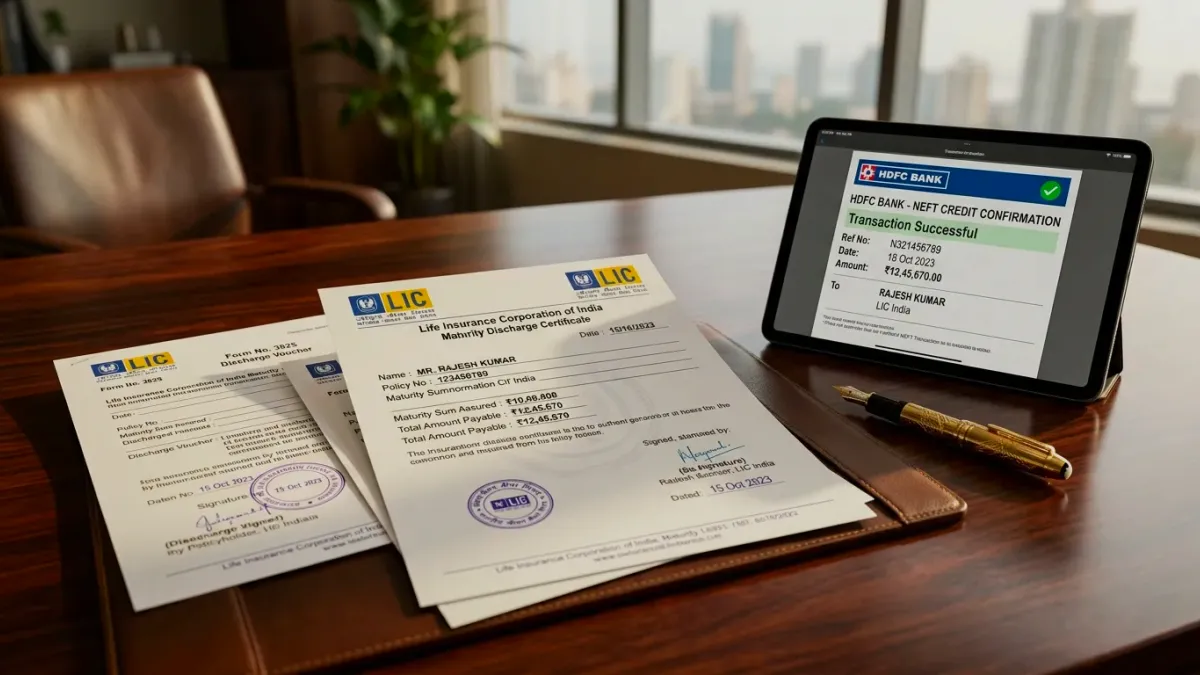
Axiom 3: LIC Disburses Exclusively via Direct Core Banking NEFT. LIC does not issue bearer cheques, cash vouchers, or UPI transfers to third parties. All claim disbursements are routed directly from LIC's central disbursement accounts to the policyholder's or verified nominee's bank account via RBI NEFT/RTGS gateways.
3.2 TRAI Alphanumeric SMS Header Protocol
The Telecom Regulatory Authority of India (TRAI) enforces strict Distributed Ledger Technology (DLT) header registration for all commercial and institutional messaging. Genuine SMS notifications from LIC of India will ALWAYS arrive with an approved 6-character alphanumeric sender ID.
VM-LICIND, VK-LICIND, AD-LICIND, JD-LICIND, BP-LICIND
Verified official transactional route for premium reminders and status alerts.
+91-98XXXXXXXX, +91-70XXXXXXXX, +91-62XXXXXXXX
Any standard 10-digit mobile number claiming to represent LIC is a criminal phishing attempt.
BZ-LICIIN, MD-BONUSC, TX-IRDAIB
Headers that spoof official acronyms. Verify sender ID before opening any attached links.
4. Physical Policy Bond Verification: Forensic Security Features
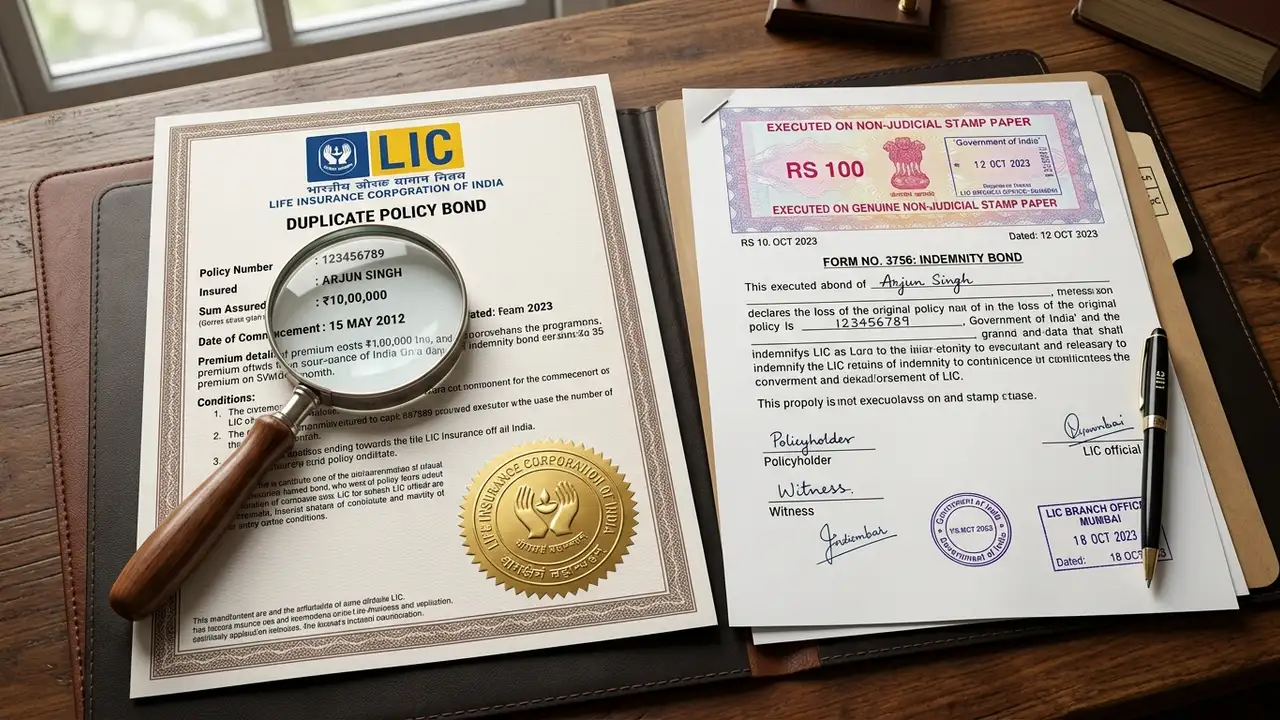
In instances of rogue offline agent activity or third-party impersonation, policyholders may be handed forged policy bonds, counterfeit renewal receipts, or altered cover notes. An authentic LIC Policy Document is a formal legal instrument of contract executed on heavy security rag paper incorporating multiple overt and covert forensic security features.
Translucent Embedded Watermark Paper
Hold the physical bond up against a strong light source. An authentic LIC policy document contains an authentic, integrated mould-made watermark featuring the Corporation's iconic corporate crest: two cupped hands sheltering a burning oil lamp, accompanied by the circular Sanskrit inscription "योगक्षेमं वहाम्यहम्" (Yogakshemam Vahamyaham). This watermark is embedded during paper manufacturing; it is not printed with surface ink and cannot be felt by rubbing a finger across the page.
Guilloche Anti-Copy Security Borders & Ashoka Emblem
The decorative outer borders of an authentic policy bond consist of intricate geometric lathe-curved patterns (Guilloche lines). When photocopied or digitally scanned, counterfeiters encounter optical moiré degradation: the razor-sharp microscopic curves blur into smudged grey bands, and hidden pantograph micro-lettering revealing "COPY" or "VOID" may emerge. The official Ashoka Pillar emblem is rendered with precise statutory micro-typography.
Unique Stationery Serial Number vs Policy Number
Every policy bond features two distinct numbers: the 9-digit Policy Number printed in the schedule box, and a separate Stationery Serial Number printed along the upper or lower marginal perimeter of the security bond paper. This stationery number is logged in the Divisional Office's physical stock register. Counterfeit bonds almost universally omit this stationery serial code or print generic dummy sequences.
Indelible Machine-Printed Policy Schedule
The tabular schedule specifying the Proposer Name, Life Assured, Date of Birth, Date of Commencement, Date of Risk, Sum Assured, Premium Paying Term, and Installment Premium is printed using specialized high-density impact or high-fusion laser typography. The ink cannot be rubbed off, erased with chemical solvents, or altered without visibly scarring the security paper fibers.
Revenue Stamp Execution & Cross-Cancellation
In accordance with the Indian Stamp Act, 1899, an authentic physical policy bond bears a physical adhesive ₹1.00 revenue stamp or an official impressed franking stamp. Crucially, the issuing branch applies an official purple or blue rubber cancellation seal stamped directly across the face of the revenue stamp, bearing the branch code, city, and execution date. An unstamped or uncancelled bond indicates a counterfeit instrument.
Authorized Signatory Seal & Digital Verification Mark
The document concludes with the signature of an authorized officer (Branch Manager or Higher Grade Assistant / Administrative Officer) accompanied by the official circular branch seal. In modern policies issued since 2022, policy bonds also feature a machine-readable 2D QR Code that resolves to LIC's secured verification server when scanned.
| Verification Parameter | Genuine LIC Policy Bond | Counterfeit / Forged Document |
|---|---|---|
| Paper Texture & Quality | Heavyweight security rag paper (crisp texture) | Standard 70-80 GSM commercial bond or copier paper |
| Embedded Watermark | Translucent hands & lamp visible against back-light | No watermark, or faint surface ink stamp that blurs |
| Serial Identification | Both 9-digit Policy No. & margin Stationery Serial No. | Only Policy No.; missing stationery stock inventory code |
| Revenue Stamp Cancellation | Official branch seal stamped diagonally across stamp | Missing revenue stamp, plain sticker, or uncancelled stamp |
| Core Database Match | Instantly verifiable on official portal and DigiLocker | Portal returns "Invalid Policy Number" or name mismatch |
5. Digital Verification Protocols: Portal, WhatsApp, SMS & DigiLocker
You never need to rely on the word of an intermediary, telemarketer, or third-party consultant to confirm the authenticity, status, or financial value of an LIC policy. Life Insurance Corporation provides four independent, tamper-proof digital channels that interface directly with its centralized core database (e-FEAP architecture).
The official LIC e-Services portal (ebiz.licindia.in) is the definitive proof of policy existence. If a policy is successfully registered and displayed on the official customer portal, it is 100% genuine and actively hosted on LIC's central mainframe.
Step-by-Step Enrollment Protocol:
1. Navigate directly to the secure URL: https://ebiz.licindia.in/b2c/ (Never use search engine ad links).
2. Click "Customer Portal" > "New User".
3. Input the four mandatory verification parameters: 9-Digit Policy Number, Basic Installment Premium (strictly excluding GST), Date of Birth (matching the proposal record), and Active Mobile Number.
4. Upon OTP validation, the system instantly links the policy. If the portal verifies the policy, you can download the official Policy Schedule, check vested bonus accretions, and verify nominee registration.
⚠️ If the system returns "Details do not match master records" repeatedly, visit your servicing branch immediately to audit the physical proposal file for fraudulent tampering.
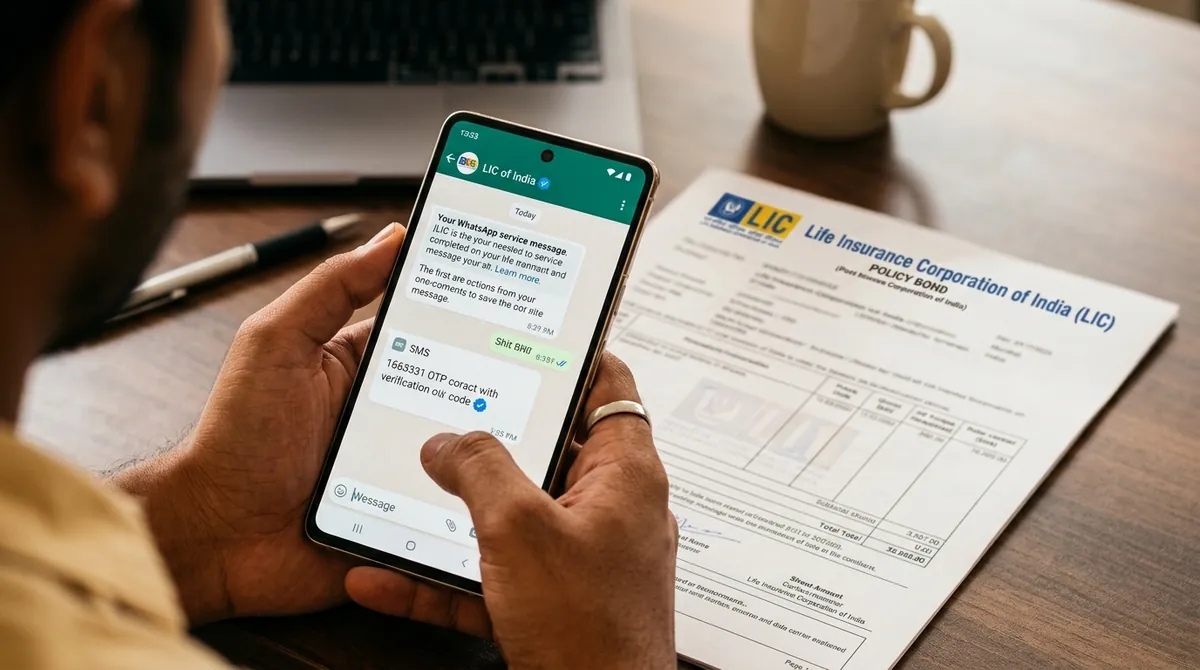
LIC operates a 24x7 automated interactive WhatsApp helpline for registered policyholders. This channel provides instantaneous confirmation of policy status, next premium due date, and official bonus accruals.
• Official Number: Save +91 8976862090 in your smartphone contacts as "LIC Official Helpline".
• Verification Check: Ensure the chat profile displays the official Meta Green Verified Checkmark alongside the name "LIC of India". Never interact with unverified numbers claiming to be LIC WhatsApp agents.
• Interactive Query: Send "Hi" from your registered mobile number. Select Option 1 (Premium Due), Option 2 (Bonus Information), or Option 3 (Policy Status) to receive instantaneous, encrypted server records.
For policyholders without internet access or smartphones, LIC provides an automated SMS inquiry gateway operating through shortcodes 9222492224 and 56767877.
Compose an SMS from your registered mobile number using the official syntax:
LICHELP <9-Digit Policy Number>
Send to 9222492224. The central server returns an encrypted SMS detailing the exact Policyholder Name, Plan Code, Policy Status (In-Force, Lapsed, or Paid-Up), and Next Due Date.
DigiLocker is the Government of India's flagship cloud repository platform under the Digital India initiative. LIC of India is an integrated Issuer Authority on the DigiLocker platform.
1. Open the DigiLocker App or visit digilocker.gov.in and authenticate via Aadhaar OTP.
2. Search for "Life Insurance Corporation of India" under the Banking, Financial Services and Insurance (BFSI) sector.
3. Select "Policy Document", enter your 9-digit policy number, and authorize consent.
4. DigiLocker performs real-time cryptographic API verification against LIC's database and fetches the digitally signed e-Policy certificate.
Legal Status: Under Section 5A of the Information Technology Act, 2000, digital policy bonds retrieved via DigiLocker carry absolute legal parity with physical documents issued by the Corporation.
6. Verifying Agent Credentials on IRDAI Bima Bharosa Portal
A pervasive tactic deployed by scam call centers is fabricating agent credentials. The caller quotes a fictional "LIC Agent License Number" or claims to be an authorized "IRDAI Recovery Executive" to legitimize their demands. Fortunately, the Insurance Regulatory and Development Authority of India maintains an open public verification registry: the Bima Bharosa Portal (formerly the Integrated Grievance Management System - IGMS).
Protocol to Audit Insurance Intermediary Credentials:
Step 1: Demand Full Identifying Particulars
If an unknown individual calls or visits claiming to represent LIC, politely demand their: Full Legal Name, 8-Digit LIC Agency Code, Servicing Branch Office Code, and IRDAI License / Registration Number. Refusal or hesitation to provide these details is an immediate indicator of fraudulent impersonation.
Step 2: Access the Bima Bharosa Public Registry
Visit the official regulatory gateway: https://bimabharosa.irdai.gov.in/. Navigate to the "Intermediary & Agent Verification" tab.
Step 3: Audit Active Licensing Status
Enter the Agency Code or Agent Name. The regulatory registry reveals whether the agent holds an active, valid license under IRDAI (Appointment of Insurance Agents) Regulations, their associated insurer (LIC of India), their license expiration date, and whether the agent has been suspended or debarred.
Step 4: Check the National Blacklist / Debarred Registry
The portal hosts a centralized debarment database of intermediaries terminated for financial embezzlement, fraudulent proposal forgery, or code of conduct violations. If the caller's code appears in the blacklist, terminate communication immediately.
Step 5: Physical LIC Agency Identity Card Inspection
For in-person visits, demand to inspect the agent's physical photo identity card issued by the Senior Divisional Manager (SDM). An authentic card features the agent's photograph, agency code, branch name, validity period, and an embossed or signed corporate seal.
7. Step-by-Step Reporting: What to Do If You Receive a Spurious Call
If you receive a spurious call, SMS, or WhatsApp message offering fake bonuses or demanding payments, swift and systematic action is critical. Proactive reporting protects your family, helps law enforcement bust organized call centers, and triggers emergency banking freezes if money has already been transferred.
Stay calm and refuse to make any commitments. Do not argue, do not provide any personal confirmation, and never disclose an OTP, UPI PIN, or bank detail. While the caller is speaking, note down:
- Exact calling telephone number (including landline or mobile prefixes).
- Date, exact time, and duration of the call.
- The name, designation, and department claimed by the caller.
- Any fictitious reference number, claim ID, or bonus voucher number quoted.
- If payment was demanded: The exact bank account number, IFSC code, or UPI ID provided.
- Save call recordings and take screenshots of incoming SMS messages and WhatsApp chats.
LIC maintains a specialized Anti-Fraud Intelligence Cell at its Central Office in Mumbai to investigate institutional impersonation and database leaks.
• Dedicated Spurious Call Email: Draft an email to spuriouscalls@licindia.in and cc co_complaints@licindia.in.
• Subject Line Format: "FRAUD ALERT: Spurious Call Report - Policy No. [Your Policy No.] - Calling No. [Scammer No.]".
• LIC 24x7 Customer Helpline: Call 022-6827 6827 and lodge an official grievance ticket with the customer care executive.
• Branch Manager Intimation: Submit a written complaint to the Manager (CRM) at your local LIC Divisional Office to flag your policy docket against unauthorized address changes or surrender requests.
CRITICAL ACTION IF FUNDS WERE TRANSFERRED: If you or a family member fell victim to a scam and transferred money via UPI, IMPS, or Net Banking, act within the "Golden Hour" (first 2 to 4 hours).
1. Dial 1930 Immediately: The National Cyber Crime Helpline (1930, formerly 155260) connects directly to the Indian Cyber Crime Coordination Centre (I4C). An operator records your transaction UTR, debit bank, and scammer's destination account.
2. Automated Inter-Bank Freezing: The 1930 system dispatches instantaneous API freeze alerts to the destination bank and payment gateways (Paytm, PhonePe, Razorpay), freezing the scammer's mule accounts before funds can be withdrawn at ATMs or routed into cryptocurrency.
3. File Formal Cyber Complaint: Log on to https://cybercrime.gov.in and file a formal financial fraud complaint under category "Financial Fraud - Online Insurance/Bonus Cheating". Download the official Acknowledgement PDF containing the Complaint Acknowledgment Number.
IRDAI maintains a dedicated Spurious Call Complaints Cell to track regulatory impersonation and coordinate with telecom operators to blacklist numbers.
• IRDAI Toll-Free Helplines: Call 155255 or 1800 4254 732 (Operational 8:00 AM to 8:00 PM, Monday through Saturday).
• Grievance Email: Send complete call records to complaints@irdai.gov.in.
• Online Registration: Log in to the Bima Bharosa portal (bimabharosa.irdai.gov.in) and register a complaint under the specific category "Spurious Call / Regulatory Impersonation".
8. Legal Consequences for Fraudsters: IPC, BNS & IT Act Framework
Impersonating insurance officials, manufacturing forged policy bonds, and orchestrating boiler-room telemarketing fraud constitute severe, non-bailable criminal offenses under Indian penal and cyber jurisprudence. Law enforcement agencies—including the Central Bureau of Investigation (CBI), state Cyber Crime Police Stations, and the Enforcement Directorate (ED)—routinely prosecute offenders under multiple statutory frameworks:
| Statutory Code | Specific Section & Offense | Maximum Punishment | Legal Classification |
|---|---|---|---|
| IPC / BNS | Section 419 IPC / Section 319(2) BNS Cheating by Personation (Posing as LIC/IRDAI official) |
Imprisonment up to 3 Years, or Fine, or Both | Cognizable & Non-Bailable |
| IPC / BNS | Section 420 IPC / Section 318(4) BNS Cheating and Dishonestly Inducing Delivery of Property |
Rigorous Imprisonment up to 7 Years + Fine | Cognizable & Non-Bailable |
| IT Act 2000 | Section 66D IT Act Cheating by Personation by Using Computer Resource |
Imprisonment up to 3 Years + Fine up to ₹1,00,000 | Cognizable |
| IT Act 2000 | Section 66C IT Act Identity Theft (Unauthorized use of OTP, password, VPA) |
Imprisonment up to 3 Years + Fine up to ₹1,00,000 | Cognizable |
| IPC / BNS | Section 467 / 468 IPC (Section 336 / 338 BNS) Forgery of Valuable Security / Document for Cheating |
Imprisonment for Life or up to 10 Years + Fine | Cognizable & Non-Bailable |
| IPC / BNS | Section 120B IPC / Section 61(2) BNS Criminal Conspiracy (Organized Call Center Gangs) |
Equal to punishment for the substantive offense | Cognizable |
Judicial Precedent & Asset Attachment: In landmark rulings delivered by the Hon'ble Supreme Court of India and various High Courts, judicial benches have affirmed that economic crimes targeting vulnerable pensioners and life insurance policyholders constitute aggravated offenses against society. Furthermore, when illicit call centers amass illegal proceeds exceeding ₹1 Crore, the Enforcement Directorate initiates prosecution under the Prevention of Money Laundering Act, 2002 (PMLA), empowering authorities to provisionally attach call center equipment, real estate properties, and bank accounts of syndicate kingpins.
9. Safe Banking Practices & Premium Hygiene for LIC Policyholders
A substantial percentage of offline fraud occurs when policyholders hand over blank signed cheques, loose currency notes, or uncrossed negotiable instruments to unauthorized intermediaries. Establishing rigorous banking hygiene guarantees that your financial resources reach the Corporation's accounts without leakage.
Rule 1: The Golden Payee Rule for Cheque Payments
Never issue a blank cheque, cash cheque, or cheque payable to an individual agent's name. When paying your premium or revival charges via physical cheque, follow this non-negotiable legal format:
Payee Line Syntax:
"Life Insurance Corporation of India - Policy No. [Insert 9-Digit Number]"
Mandatory Crossing: Draw two parallel transverse lines across the top left corner of the cheque and write "ACCOUNT PAYEE ONLY" between the lines. Under Section 131 of the Negotiable Instruments Act, 1881, this restricts negotiability, legally prohibiting any bank from depositing the instrument into an account other than the Life Insurance Corporation of India.
Rule 2: Insist on Instant Machine-Generated Computerized Receipts
If paying renewal premiums in cash or via cheque at a branch counter or authorized Premium Collection Point (such as an authorized Life Plus Kendra or Chief Life Insurance Advisor - CLIA point), never accept a handwritten voucher, unsigned slip, or temporary diary entry.
- Demand an authentic, computerized real-time receipt printed on official continuous stationery.
- Verify that the receipt displays a unique 14-Digit Machine Receipt Number.
- Confirm the printed Policy Number, Plan, Term, and Premium Amount match your records precisely.
- Ensure the cashier stamp and date/time imprint appear clearly on the receipt leaf.
Rule 3: Authenticated Digital Payment Channels Only
When executing online digital payments, utilize strictly verified corporate channels:
licindia.in or ebiz.licindia.in (Quick Pay / Customer Portal).
10. Real Case Studies & Actuarial Red Flag Detection Matrix
Examining authentic, documented case studies analyzed by forensic fraud examiners highlights the devastating financial damage inflicted by spurious call syndicates—and illustrates how simple actuarial verification would have prevented the loss.
Case Study 1: The "₹4.8 Lakh Lapsed Bonus" Trap in Pune
₹68,000 DefraudedThe Profile: A 66-year-old retired Indian Railways employee holding an LIC Jeevan Kishore policy that had lapsed twelve years earlier due to non-payment after paying premiums for only four years.
The Scam Execution: The victim received a call from an individual identifying himself as "Deputy Director Sharma from the IRDAI Unclaimed Fund Settlement Directorate, New Delhi". The caller accurately quoted the victim's old policy number and stated: "Sir, your policy has an accumulated unclaimed loyalty bonus of ₹4,82,000. Under Special Cabinet Orders, the fund will be permanently absorbed by the government unless claimed. To initiate immediate NEFT disbursement, you must deposit ₹28,000 as a File Processing & Stamp Clearance Fee."
The victim transferred ₹28,000 via Google Pay to a designated account. Two days later, an accomplice called claiming to be an "Income Tax Nodal Officer", demanding an additional ₹40,000 for a "Section 194DA Tax Clearance Certificate". The victim paid that as well. When a third call arrived demanding ₹55,000 for "RBI Conversion Endorsement", the victim approached his local LIC branch, only to discover the entire narrative was a complete cyber fraud.
licsodho.in would have instantly exposed.
Case Study 2: The "Surrender & Transfer into 14% Plan" Scam in Bengaluru
₹3,40,000 Capital LossThe Profile: A 44-year-old software architect holding a high-value LIC Jeevan Anand (Plan 149) policy with a Sum Assured of ₹20,00,000, actively running in its 11th policy year with timely annual premium payments.
The Scam Execution: A telemarketer posing as an "LIC Senior Portfolio Advisory Officer" contacted the policyholder, claiming that LIC was launching a "National Sovereign Growth Scheme" offering guaranteed 14.5% tax-free returns. The caller convinced the policyholder that continuing the old Jeevan Anand policy was financially foolish because it yielded only 5%.
Under the caller's instructions, the policyholder visited his home branch, signed Form No. 5074 (Surrender Application), and surrendered the policy. The branch disbursed a Special Surrender Value of ₹7,80,000. Immediately upon receiving the funds, the telemarketer arrived at the policyholder's residence with pre-filled application forms for a private life insurer's market-linked ULIP policy with a 5-year premium commitment of ₹5,00,000 annually.
| Operational Indicator | Genuine LIC Operation | Spurious Phishing Scam |
|---|---|---|
| Communication Channel | Official SMS headers (VM-LICIND), Speed Post, Branch Notice | Standard 10-digit mobile numbers, WhatsApp audio calls |
| Caller Identity | Official branch officials (verifiable on branch landline) | "IRDAI Bonus Cell", "Central Audit Directorate", "Ministry" |
| Tone & Urgency | Formal, structured, statutory grace periods observed | Extreme urgency: "Claim within 24 hours or funds forfeit" |
| Upfront Fee Demand | ZERO fee. No advance charges for claim disbursement | Demands "Processing Fee", "GST Deposit", or "Stamp Charge" |
| Payment Destination | Direct Core Banking NEFT credit to policyholder account | UPI handles (PhonePe/GPay) or personal bank accounts |
| Handling of Existing Policies | Encourages policy revival and long-term continuity | Aggressively pushes surrender or porting to private plans |
| OTP / Banking Requests | NEVER asks for bank password, card CVV, or mobile OTP | Coerces policyholder to read out SMS verification codes |
11. Frequently Asked Questions (8 Actuarially Validated Answers)
Does LIC ever call policyholders offering cash bonus payouts or prize money?
No. LIC of India never initiates phone calls offering cash bonus disbursements, lottery distributions, or promotional gift vouchers. Under statutory actuarial regulations, bonuses declared on participating policies are non-cash additions that are credited to your policy account and payable solely upon death, maturity, or formal surrender.
Can I withdraw my accrued LIC bonus as cash while keeping my policy running?
No. In all traditional with-profit endowment, money-back, and whole-life plans, simple reversionary bonuses are non-withdrawable during the policy term. There is zero provision in LIC's rules to withdraw accumulated bonuses as standalone cash without surrendering the underlying policy or taking an official policy loan against the surrender value.
What should I write on the cheque payee line when paying my LIC renewal premium?
Always write strictly: "Life Insurance Corporation of India - Policy No. [Your 9-Digit Policy Number]" on the payee line. Never issue cheques payable to individual agents or agency names, and always draw double parallel transverse lines across the top left corner with the words "ACCOUNT PAYEE ONLY" to prevent diversion.
How do I immediately freeze funds if I was tricked into transferring money to a scammer?
Dial the National Cyber Crime Helpline at 1930 immediately within the "Golden Hour" (first 2 to 4 hours). Provide the transaction UTR number, debit bank, and the recipient's bank account or UPI ID so law enforcement can trigger an automated API freeze on the intermediate mule accounts, followed by registering a complaint on cybercrime.gov.in.
How can I confirm if a physical policy document or premium receipt is 100% genuine?
Inspect the physical bond for the translucent mould-made watermark featuring LIC's cupped-hands crest when held up against light, verify the unique stationery serial number on the margin, and ensure the revenue stamp bears an official branch cancellation seal. The definitive digital confirmation is enrolling the policy on the official portal at ebiz.licindia.in or fetching it via DigiLocker.
Can an LIC agent or caller transfer my policy money into another insurance company?
No. Life insurance policies in India are individual, sovereign contracts that cannot be "ported" or transferred between insurers like mobile phone connections. Any agent claiming they can transfer your LIC policy value into a private insurer's plan is deceiving you into surrendering your policy at a severe loss to pocket a fresh sales commission.
Is a digital policy document fetched from DigiLocker legally recognized in India?
Yes. Under Section 5A of the Information Technology Act, 2000, electronic policy records retrieved via DigiLocker from LIC's issuer repository enjoy full legal equivalence with physical original policy bonds for all servicing actions, income tax Section 80C deductions, and identity verifications.
Where can I check if an individual is an officially authorized LIC agent?
You can verify an intermediary's credentials on the IRDAI Bima Bharosa portal at bimabharosa.irdai.gov.in using their 8-digit Agency Code, full legal name, and servicing Branch Code. This regulatory database confirms active licensing status, validity dates, and checks whether the intermediary appears on the national debarred blacklist.
Content validated against IRDAI (Protection of Policyholders' Interests) Regulations, Insurance Act 1938 (Sections 39, 41, 45), Information Technology Act 2000 (Section 66D), Indian Penal Code Sections 419/420 (Bharatiya Nyaya Sanhita Sections 318/319), and Life Insurance Corporation of India Master Anti-Fraud & Public Warning Directives (2025-2026).