1. The General Exemption Rule: Section 10(10D) Foundations
For decades, one of the most compelling incentives for investing in Life Insurance Corporation of India (LIC) endowment, whole life, and money-back contracts has been the total tax exemption granted under Section 10(10D) of the Income Tax Act, 1961.
Under the baseline statutory rule, any sum received under a life insurance policy—including maturity proceeds, interim survival benefits (money-back installments), and allocated simple reversionary or final additional bonuses—is completely excluded from total taxable income.
The Income Tax Act maintains an unassailable statutory shield over death claim settlements. Any sum received upon the death of the life assured is 100% tax-free for the nominee, regardless of the annual premium amount, policy issue date, plan type, or premium-to-sum-assured ratio.
However, recent landmark amendments introduced by the Finance Act 2021 and Finance Act 2023 have fundamentally restricted the tax exemption for high-net-worth policyholders receiving maturity payouts. Navigating these modern thresholds requires understanding the precise dates and premium caps governing each policy category.
2. The ₹5 Lakh Annual Premium Rule (Post-April 2023 Policies)
In the Union Budget 2023, the Ministry of Finance enacted a structural reform targeting high-ticket non-linked traditional insurance policies (Endowment plans like Jeevan Labh 936, New Endowment 914, Jeevan Umang 945, and Bima Jyoti 860):
- Effective Date: Applies strictly to non-linked life insurance policies issued on or after April 1, 2023.
- The ₹5,00,000 Aggregate Cap: If the total annual premium payable across all non-linked life insurance policies held by an individual exceeds ₹5,00,000 in any financial year during the policy tenure, the maturity proceeds from those excess policies will NOT be exempt under Section 10(10D).
- Net Income Taxation: When a policy is disqualified from Section 10(10D), the entire gross payout is not taxed. Instead, the taxable income equals:
Total Maturity Proceeds Received minus Total Base Premiums Paid (which were not claimed as deduction). This net profit is added to your total income and taxed under the head "Income from Other Sources" at your normal slab tax rate.
Policies issued on or before March 31, 2023 are fully grandfathered by law! Even if your annual premium is ₹10 Lakhs, ₹25 Lakhs, or ₹1 Crore per year, 100% of your maturity proceeds and accrued bonuses remain completely tax-exempt under Section 10(10D), provided the policy complied with the 10% sum assured ratio test at inception.
3. CBDT Circular No. 15/2023: How Exemption is Computed
To eliminate ambiguity regarding how policyholders holding multiple policies should calculate their tax liability, the Central Board of Direct Taxes (CBDT) issued Circular No. 15/2023 on August 16, 2023, establishing clear operational guidelines:
- Principle of Policyholder Choice: The CBDT explicitly affirmed that if an individual holds multiple policies whose aggregate premium exceeds ₹5,00,000, the policyholder has the legal right to select which specific policies to treat as exempt under Section 10(10D), provided their combined annual premium does not exceed ₹5,00,000.
- GST Excluded from Threshold: The ₹5,00,000 threshold applies strictly to the base installment premium excluding Goods and Services Tax (GST), extra underwriting mortality loadings, and optional rider premiums (such as Accidental Death and Disability Rider).
- Lifetime Aggregate Tracking: The limit applies cumulatively across all non-linked life insurance policies held across all insurers in India (including private insurers like HDFC Life, ICICI Prudential, and SBI Life alongside LIC).
4. The 10% Premium to Sum Assured Ratio Test
Even if your annual premium is under ₹5,00,000, your policy must satisfy the statutory Premium-to-Sum-Assured Ratio Test under Section 10(10D)(c) and (d) to qualify for tax-free maturity:
| Policy Issue Date Window | Maximum Allowable Annual Premium | Minimum Basic Sum Assured Required | Tax Consequence if Breached |
|---|---|---|---|
| Issued On or After April 1, 2012 | Maximum 10% of Basic Sum Assured | Minimum 10 Times Annual Premium | Maturity fully taxable; 5% TDS under 194DA |
| For Persons with Disability (u/s 80U / 80DDB) | Maximum 15% of Basic Sum Assured | Minimum 6.67 Times Annual Premium | Maturity fully taxable if premium > 15% SA |
| Issued Before April 1, 2012 | Maximum 20% of Basic Sum Assured | Minimum 5 Times Annual Premium | Maturity fully taxable if premium > 20% SA |
Actuarial Note: All standard retail individual LIC policies sold today (including Jeevan Labh, Jeevan Anand, and Single Premium Endowment) are strictly designed to provide a minimum of 10 times life cover on regular premium plans. However, single premium policies with a basic sum assured of 1.25 times premium (such as Dhan Vriddhi Plan 869 Option 1) fail the 10x test and are taxable at maturity!
5. ULIP Policies vs Traditional Plans: The ₹2.5 Lakh Threshold
Unit Linked Insurance Plans (ULIPs), such as LIC's SIIP (Plan 852) and Nivesh Plus (Plan 849), are governed by distinct taxation rules established under the Finance Act 2021:
- The ₹2,50,000 Threshold: For ULIP policies issued on or after February 1, 2021, if the aggregate annual premium payable exceeds ₹2,50,000, the maturity proceeds are not exempt under Section 10(10D).
- Capital Gains Treatment: Unlike traditional policies which are taxed as "Income from Other Sources" at slab rates, high-value ULIPs are treated as equity-oriented financial assets under Section 112A. Maturity proceeds are subject to Long-Term Capital Gains (LTCG) tax at 12.5% on gains exceeding ₹1.25 Lakh per financial year (as updated by Finance Act 2024).
6. Section 194DA TDS Rules & Form 15G / 15H Exemption
When an insurance payout fails to meet the exemption criteria of Section 10(10D), the Life Insurance Corporation of India is statutorily mandated to deduct Tax Deducted at Source (TDS) at the time of payment under Section 194DA:
• TDS Rate and Base (5% on Net Income Only):
Following judicial clarifications and CBDT guidelines, LIC does not deduct TDS on the gross maturity check. TDS is deducted at 5% strictly on the net income component (Maturity Amount minus Total Premiums Paid).
• De Minimis Exemption Limit (₹1,00,000 Threshold):
No TDS is deducted under Section 194DA if the total taxable profit component across all insurance payouts during the financial year is less than ₹1,00,000.
• Punitive 20% TDS Rate for Non-Linked PAN:
Under Section 206AA, if the policyholder fails to furnish a valid PAN, or if the PAN is marked inoperative due to failure to link with Aadhaar, LIC is statutorily compelled to deduct TDS at 20% on the entire payout.
• Form 15G / 15H Submission for Zero TDS:
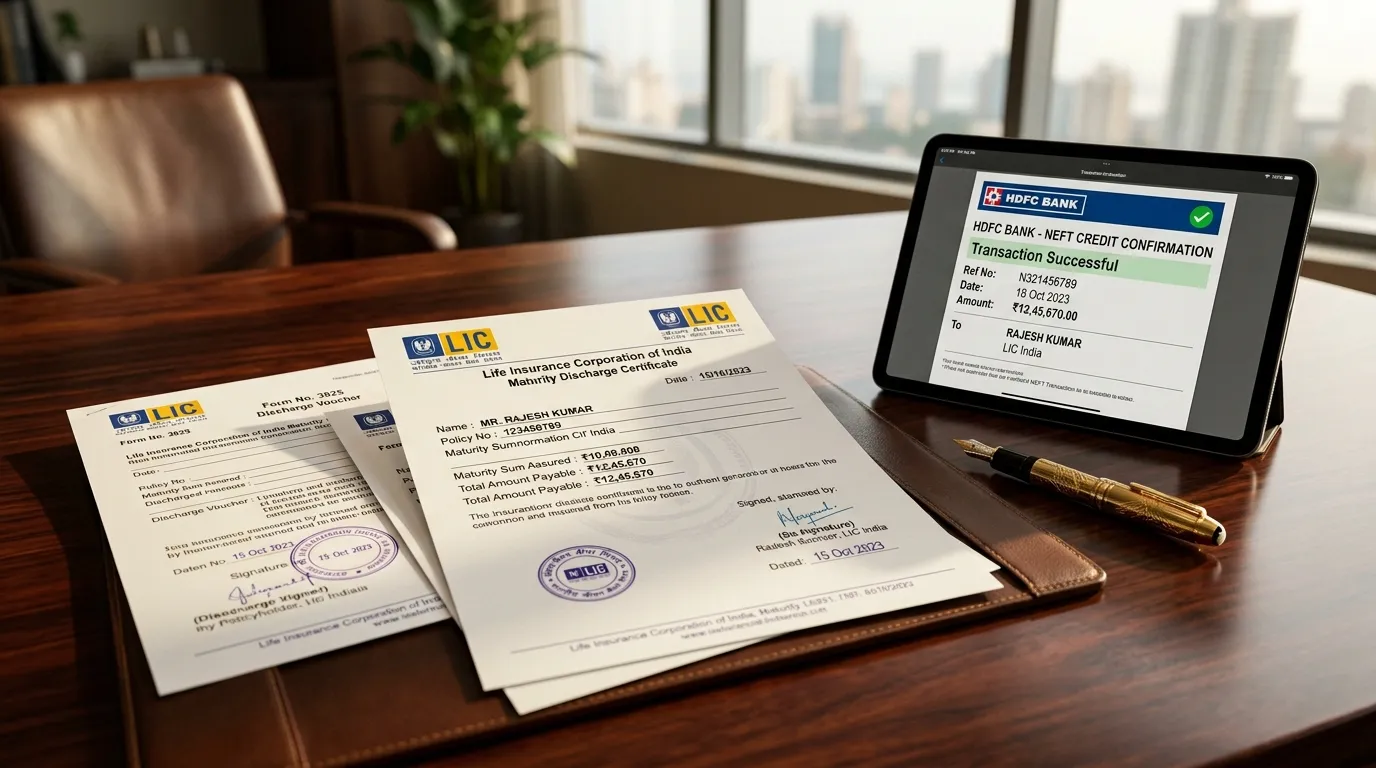
If your total estimated taxable income for the financial year (including the taxable portion of maturity returns) is below the basic tax exemption limit (₹2,50,000 under old tax regime or ₹3,00,000 under new tax regime), you can submit Form 15G (or Form 15H for senior citizens aged 60+) to your home servicing branch alongside the maturity discharge voucher to receive 100% of proceeds without TDS.
7. Mathematical Case Study: Managing Multiple Policies
Let us examine an authentic portfolio scenario illustrating how policyholders can legally minimize tax by strategically applying CBDT Circular No. 15/2023:
Scenario: Investor with 3 LIC Traditional Policies Issued in May 2023
| Policy Identifier | Annual Premium (excl GST) | Sum Assured | Term | Maturity Proceeds |
|---|---|---|---|---|
| Policy A (Jeevan Labh) | ₹2,00,000 | ₹20,00,000 | 16 Years | ₹34,00,000 |
| Policy B (New Endowment) | ₹2,50,000 | ₹25,00,000 | 15 Years | ₹40,00,000 |
| Policy C (Bima Jyoti) | ₹1,50,000 | ₹15,00,000 | 20 Years | ₹28,00,000 |
| Total Combined | ₹6,00,000 (Exceeds ₹5L Cap) | — | — | — |
Optimal Tax Strategy for Policyholder:
The policyholder's total annual premium is ₹6,00,000 (breaching the ₹5,00,000 threshold by ₹1,00,000). Under CBDT rules, the investor can select which combination to claim as exempt:
- Selection: Policy A (₹2,00,000) + Policy B (₹2,50,000) = ₹4,50,000 Total Premium. Because this combination is ≤ ₹5,00,000, both Policy A and Policy B are 100% tax-free under Section 10(10D)!
- Taxable Payout on Policy C: Only Policy C will be disqualified from Section 10(10D).
- Taxable Arithmetic on Policy C:
• Maturity Proceeds: ₹28,00,000
• Less Total Premiums Paid (₹1,50,000 × 20): ₹30,00,000
• Net Profit = ₹0 (In fact, if premiums exceed maturity, taxable income is zero!). If maturity was ₹38,00,000, taxable gain would be ₹8,00,000 taxed at slab rates.
8. Step-by-Step ITR Reporting Guide (ITR-1 vs ITR-2)
Whether your LIC maturity proceeds are completely tax-exempt or subject to income tax, statutory disclosure in your Annual Income Tax Return is mandatory to prevent automated scrutiny notices from the e-Filing portal:
Scenario 1: Reporting 100% Tax-Exempt Payouts under Section 10(10D)
- Applicable ITR Form: Can be filed using standard ITR-1 (Sahaj) or ITR-2.
- Schedule to Select: Navigate to Schedule EI (Exempt Income).
- Dropdown Option: Select
Section 10(10D) - Any sum received under a life insurance policy. - Values to Input: Enter the gross maturity amount received. This ensures your bank credit matches your tax return without adding a single rupee to your tax payable.
Scenario 2: Reporting Taxable Payouts (Premiums > ₹5 Lakhs or Sum Assured < 10x)
- Applicable ITR Form: Requires filing ITR-2 or ITR-3.
- Schedule to Select: Navigate to Schedule OS (Income from Other Sources).
- Dropdown Option: Under Any other income, report the net profit (Maturity proceeds minus non-deducted base premiums).
- Claiming TDS Credit: Check Schedule TDS-2. Verify that the 5% TDS deducted by LIC matches the entry in your Form 26AS and Annual Information Statement (AIS). The tax deducted will be credited directly against your final income tax liability.