In the modern landscape of Indian life insurance, a policy bond is only as liquid as the electronic banking mandate attached to it. For decades, policyholders and grieving beneficiaries endured multi-week delays, postal losses, and fraudulent cheque interception when receiving policy maturity proceeds, survival benefit installments, or surrender disbursements. Under regulatory mandates codified by the Insurance Regulatory and Development Authority of India (IRDAI) and Master Circulars issued by the Life Insurance Corporation of India (LIC), all paper-based disbursement cheques have been permanently abolished in favor of direct National Electronic Funds Transfer (NEFT).
Whether you hold a traditional endowment plan such as Jeevan Labh (Plan 936), a milestone-driven Money-Back policy (Plan 920/921), an annuity pension like Jeevan Shanti (Plan 858), or a high-value term insurance contract, your accumulated policy funds cannot be legally disbursed without an active, verified NEFT mandate in LIC's central enterprise database (e-FEAP). This definitive operational manual provides the complete regulatory, procedural, and actuarial blueprint for updating your bank details using official LIC Form 5821, validating banking credentials, and preventing payment rejections.
1. Statutory Mandate: Why IRDAI Prohibited Physical Paper Cheques
Historically, the issuance of paper dividend warrants and physical payout cheques represented the single largest source of consumer grievances across the Indian insurance sector. Thousands of physical cheques were lost in postal transit, delivered to obsolete residential addresses, or returned undelivered due to minor spelling discrepancies. Under the IRDAI (Protection of Policyholders' Interests) Regulations and Reserve Bank of India (RBI) Payment and Settlement Systems directives, life insurers are legally required to establish direct electronic payment pipelines with policyholders.
The transition to mandatory NEFT direct credit serves four primary actuarial and consumer protection objectives:
- Elimination of Stale Cheque Losses: Under Section 138 of the Negotiable Instruments Act, physical cheques expire 90 days after issuance. Policyholders who failed to encash their cheques within 3 months faced complex re-validation procedures, indemnity bonds, and administrative charges. Direct NEFT completely removes the risk of stale instruments.
- Interception & Fraud Mitigation: Physical cheques sent via ordinary post were vulnerable to theft, chemical alteration of payee names, and illicit encashment through cooperative bank mule accounts. NEFT routes funds directly into an authenticated Core Banking System (CBS) account matching the Policyholder’s verified Permanent Account Number (PAN).
- Zero Clearance Lag & Float Exploitation: Outstation cheques historically took between 7 to 21 business days to clear across regional clearing houses, depriving policyholders of immediate interest income. RBI NEFT settlement operates on a 24x7x365 batch clearing cycle settling every 30 minutes.
- Statutory Audit Trail & TDS Compliance: Direct electronic transfers provide an immutable Reserve Bank of India UTR (Unique Transaction Reference) number, synchronizing seamlessly with the Income Tax Department's Annual Information Statement (AIS) and Form 26AS for Section 194DA tax compliance.
Under internal operational instructions issued to all 2,048 LIC branches, cashiers and branch claim settlement officers are strictly prohibited from generating physical payout instruments for maturity claims, survival benefits, or surrender applications exceeding ₹10,000. If your servicing branch does not possess a verified NEFT mandate on file, your disbursement will remain indefinitely parked in LIC's "Stale & Unpaid Claims Sundry Account", earning zero interest after the scheduled due date!
2. Comprehensive Scope: All LIC Policy Payouts Covered Under NEFT
An updated NEFT mandate does not simply serve your eventual policy maturity. It functions as an overarching financial bridge connecting your policy's entire lifecycle directly to your primary bank account. Once an NEFT mandate is registered in LIC's e-FEAP core system, all financial transactions pertaining to that policy contract are automatically credited without requiring fresh banking submissions for each event.
| Payout Category | Trigger Event & Frequency | Statutory Form Required | NEFT Beneficiary |
|---|---|---|---|
| Maturity Claims | Completion of full policy tenure (e.g. 15, 20, 25 years) | Form 3825 (Discharge Voucher) | Life Assured (Policyholder) |
| Survival Benefits (SB) | Periodic milestones in Money-Back Plans (Every 3, 4, or 5 yrs) | Automatic (Pre-registered NEFT) | Life Assured (Policyholder) |
| Policy Surrender Payout | Voluntary early contract termination (GSV / SSV) | Form 5074 (Surrender Discharge) | Life Assured (Policyholder) |
| Policy Loan Disbursal | Secured policy loan against acquired cash surrender value | Form 5196 / 5205 (Loan Agreement) | Borrower / Life Assured |
| Pension / Annuity Payouts | Monthly, quarterly, half-yearly, or annual annuity credits | Annual Digital Life Certificate (DLC) | Annuitant |
| Death Benefit Claims | Untimely demise of the Life Assured during active risk cover | Form 3783 / 3801 (Death Claim) | Designated Nominee / Legal Heir |
| Excess Premium Refund | Double payments, underwriting medical loading refunds, or cancelations | Proposal Cancellation Voucher | Proposer / Life Assured |
For policyholders enrolled in money-back contracts like Jeevan Tarun (Plan 934), Bima Bachat (Plan 948), or New Money Back 20 Years (Plan 920), having an active NEFT mandate completely automates cash flow. The central e-FEAP system triggers milestone disbursements automatically on the exact policy anniversary date without requiring policyholders to visit the branch, sign discharge vouchers, or submit reminder letters. The funds land directly in your bank account via automated CBS clearing!
3. Official LIC Form 5821: Line-by-Line Anatomy & Field Instructions
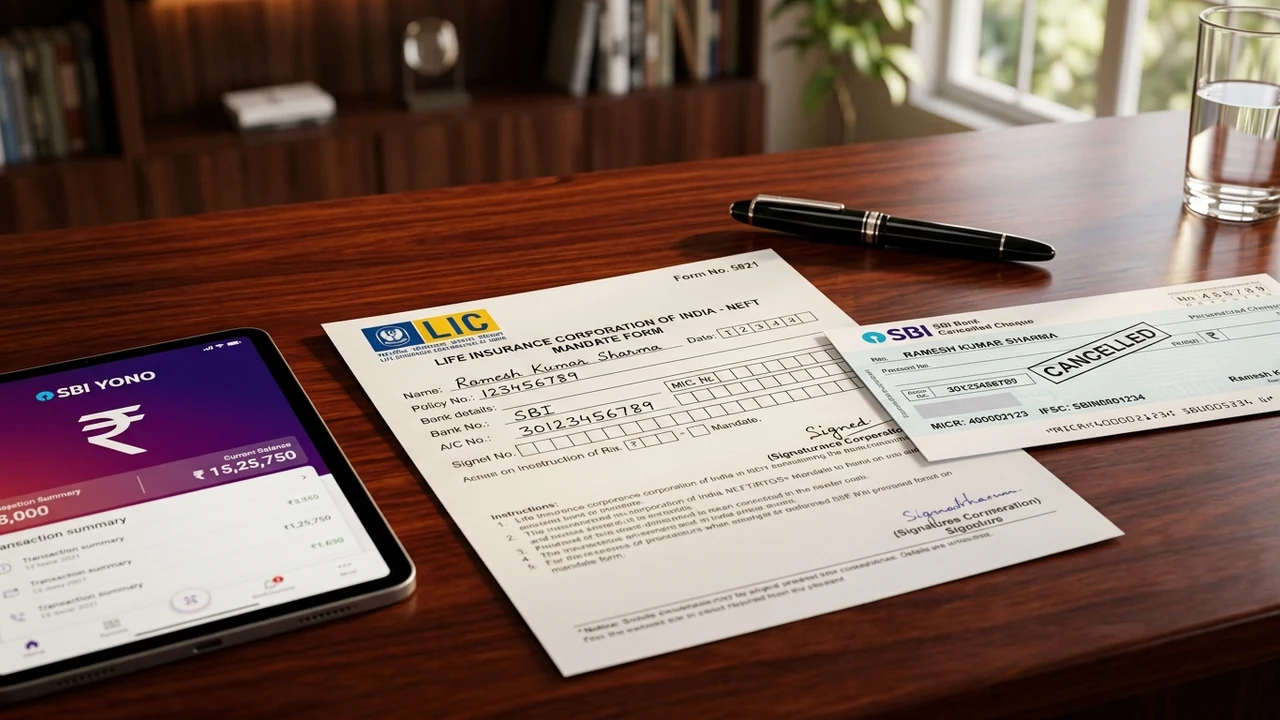
The standard legal instrument for registering or updating bank details across the Corporation's branch network is LIC Form No. 5821, officially titled the "Mandate Form for Electronic Funds Transfer (NEFT)". To avoid administrative rejections, policyholders must understand the exact architecture of this statutory document.
One of the most cost-effective and convenient provisions of Form 5821 is that a single form can be utilized to register bank details for up to six different policies, provided that all listed policies belong to the identical Life Assured and share the exact same servicing division or branch cluster.
📋 Critical Field-by-Field Breakdown of Form 5821
- 1. Policy Details Grid: Space is provided for up to 6 distinct policy numbers. Enter the 9-digit policy numbers clearly. Ensure you do not mix policies belonging to your spouse or children on your individual mandate form; each unique individual must submit a separate Form 5821.
- 2. Policyholder / Annuitant Name: Write your full legal name exactly as it appears in the policy bond and your bank account records. If there is a minor spelling discrepancy between the policy bond and bank passbook, an additional identity affidavit or PAN verification may be mandated.
- 3. Bank Name & Branch Address: Specify the full commercial name of your scheduled commercial bank (e.g., State Bank of India, HDFC Bank Ltd, Punjab National Bank) along with the specific physical branch locality and city.
- 4. Account Type: Tick the appropriate checkbox: Savings Bank (SB) or Current Account (CA). Joint accounts are permitted only under specific survivorship clauses (detailed in Section 9).
- 5. Core Banking Account Number (CBS): Enter your complete computerized bank account number (typically between 11 and 16 digits). Never enter old ledger account numbers or truncated numbers printed on non-CBS cheque slips.
- 6. 11-Digit IFSC Code: The Indian Financial System Code (IFSC) assigned by the Reserve Bank of India. Crucial: The fifth character is always the numerical digit zero ("0"), never the letter "O". Writing an incorrect IFSC will lead to immediate electronic rejection at the clearing gateway.
- 7. 9-Digit MICR Code: Magnetic Ink Character Recognition code printed on the bottom white strip of your cheque leaf next to the cheque number. This assists in secondary clearing routing.
- 8. Mobile Number & Email ID: Mandatory for receiving automated SMS dispatch alerts containing the NEFT UTR number once the fund transfer is triggered by the divisional finance cell.
- 9. Signature of the Policyholder: The policyholder must sign Form 5821 exactly matching their signature recorded on the original proposal form. If your signature has evolved over time, a signature verification attestation by your bank branch manager is mandatory.
4. Mandatory Bank Proof Standards: Cancelled Cheque vs Passbook Rules
Submitting Form 5821 alone is legally insufficient. Under anti-money laundering (AML) and know-your-customer (KYC) operational standards, LIC mandates strict physical proof of account ownership to ensure funds cannot be diverted into third-party accounts.
The Corporation accepts three distinct categories of bank verification documents, categorized by regulatory hierarchy:
The single most preferred and frictionless document is an original cancelled cheque leaf from your bank cheque book. To be valid, the cheque leaf MUST have the policyholder's full name pre-printed by the bank in computerized ink directly above the signature line. Draw two parallel transverse lines across the top-left corner and clearly write "CANCELLED" between them. Never write over the MICR band or account number.
If you maintain a non-cheque savings account or do not possess a physical cheque book, you may submit a crisp, legible photocopy of the front cover/first page of your bank passbook. The page must visibly display: your full legal name, complete CBS account number, bank branch address, 11-digit IFSC, and the official bank seal and signature of the issuing branch official. You must sign your own self-attestation across the bottom margin.
For digital-only banks or internet accounts without physical passbooks, submit an official bank account statement covering the preceding 3 months. Crucial: Internet e-statements downloaded from net-banking are NOT accepted without a wet physical stamp and signature from your local bank branch manager confirming account ownership and KYC compliance.
Never submit a starter cheque or non-personalized cheque where the policyholder's name is left blank or written by hand in pen! LIC branch scrutiny officers will summarily reject any cheque leaf where the account holder's name is not professionally printed by the bank's security press. If your bank issued you non-personalized starter cheques, you must submit a certified passbook copy instead.
5. Step-by-Step Submission Procedure: Branch Submission vs Portal Linkage
Updating your bank account can be executed through two distinct pathways depending on your account registration status with the Corporation.
Pathway A: Physical Submission at Any LIC Servicing Branch (Universal Protocol)
While policy surrender and death claims generally require visiting the original home servicing branch, NEFT Mandate Form 5821 can be physically submitted at ANY of LIC's 2,048 branch offices across India under the Corporation's unified All-India Branch Network.
Download & Complete Form 5821
Download the official Form 5821 PDF from the official LIC portal or collect a physical pre-printed form from your nearest branch counter. Fill in all fields in clear blue or black ink without white-out fluid corrections.
Attach Personalized Cancelled Cheque & Self-Attested PAN
Staple your personalized cancelled cheque leaf directly to the back of Form 5821. Attach a self-attested photocopy of your PAN card to facilitate Section 194DA tax deduction mapping.
Submit at Branch Policy Servicing / PS Counter
Hand over the physical dossier to the Policy Servicing (PS) department assistant. The official will perform an instant pre-scrutiny checking policy active status, signature matching on the e-FEAP screen, and IFSC validity.
Obtain Stamped Acknowledgement Counterfoil
Always ensure the receiving clerk cuts or signs the bottom acknowledgement tear-off slip, applying the official branch round date stamp and entering their employee SR number. This receipt is your permanent legal proof of submission.
Pathway B: Online NEFT Registration via LIC Customer Portal (Premier Services)
If you have already registered for LIC Premier Services (which requires a one-time physical KYC verification), you can upload bank details digitally without stepping into a branch:
- Log in to the official LIC Customer Portal (
ebiz.licindia.in) using your User ID and MPIN. - Navigate to the top horizontal menu bar and select "Online Services" → "Bank Account Registration".
- Select the enrolled policy numbers you wish to link from your registered policy portfolio.
- Input your 11-digit IFSC code; the portal will automatically display the corresponding Bank Name and Branch locality for cross-verification.
- Type your Core Banking Account Number twice for dual-entry confirmation.
- Upload a crisp color scan (PDF or JPEG format, under 200 KB) of your personalized cancelled cheque.
- Authenticate the electronic submission using a 6-digit Aadhaar OTP or Mobile OTP sent to your registered phone.
6. The e-FEAP Core Banking & Automated ₹1 Penny-Drop Architecture
Behind the counter, LIC's internal electronic accounting platform—known as e-FEAP (Enterprise Financial Engineering and Analytical Platform)—handles the technical integration with the National Payments Corporation of India (NPCI) and commercial clearing banks.
To ensure foolproof accuracy and prevent financial loss, LIC deploys an automated Maker-Checker & Penny-Drop Protocol:
Branch assistant keys in the 11-digit IFSC and CBS Account number from Form 5821 into the e-FEAP module.
Higher-grade branch officer cross-checks physical cancelled cheque against on-screen data and authorizes registration.
System automatically sends a ₹1 micro-credit via NPCI API. System validates that the beneficiary name matches policy records!
If the name returned by the recipient bank via the NPCI penny-drop response matches the Life Assured's name with an algorithmic similarity score exceeding 85%, the NEFT mandate is permanently marked "APPROVED & ACTIVE" in e-FEAP. If the account is blocked, frozen, closed, or the names diverge significantly, the transaction flags an immediate system rejection alert.
7. Turnaround Time (TAT), SMS Alerts & NEFT Settlement Timelines
Under LIC's Citizen Charter and IRDAI Service Standards, branch offices operate under strict statutory timelines for processing electronic banking mandates:
| Processing Phase | Standard Turnaround Time (TAT) | Status Notification Channel |
|---|---|---|
| Branch Counter Data Inwarding | Same working day (Immediate counter receipt) | Physical Stamped Counterfoil Slip |
| e-FEAP Data Entry (Maker Stage) | Within 24 business hours | Internal workflow queue |
| Officer Scrutiny & Approval (Checker) | Within 48 business hours | SMS confirmation sent to registered mobile |
| Live NEFT Claim Disbursal (RBI Cycles) | Batch settled every 30 mins (Within 2 to 4 hrs) | SMS alert with 16-character RBI UTR Number |
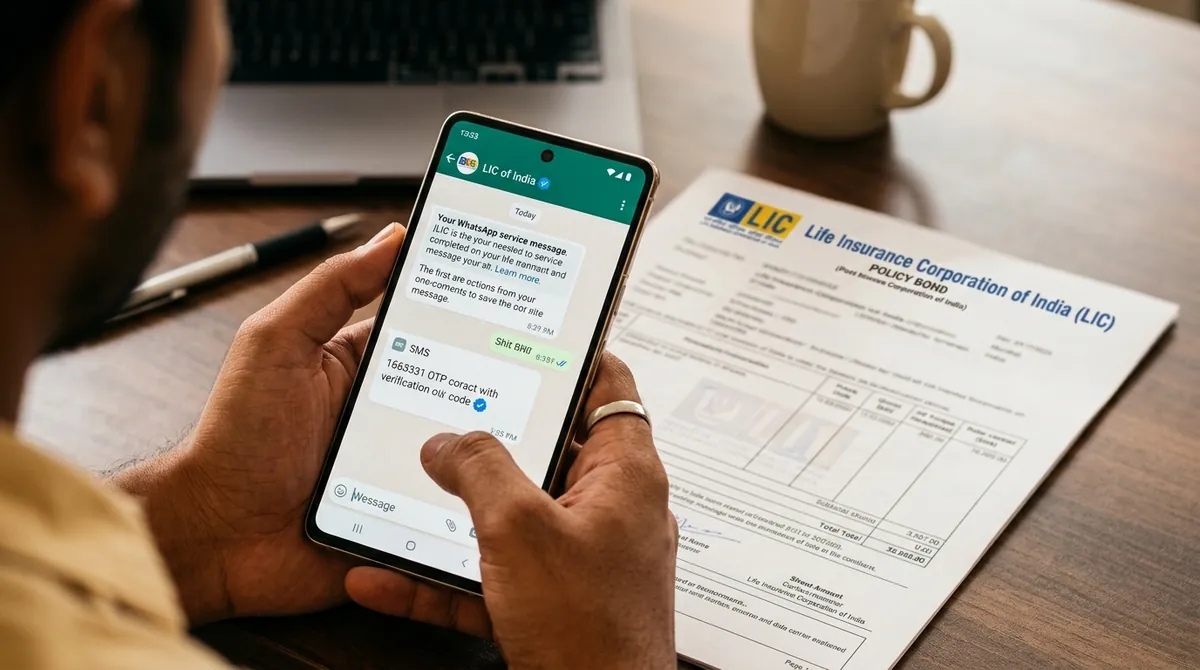
Sample Official SMS Notification: Once your mandate is approved, you will receive an official text alert originating from header LICIND or LICPRM:
8. Mathematical Case Study: Stale Physical Cheques vs Direct NEFT Credit
To demonstrate the immense tangible financial value of registering an active NEFT mandate, consider the actuarial comparison of an Indian policyholder who experienced a physical cheque delay versus an automated electronic settlement.
Financial Impact: ₹8,50,000 Maturity Settlement (Cheque vs NEFT)
❌ Scenario A: Legacy Paper Cheque (No NEFT)
Maturity Date: March 15, 2026 (Payout: ₹8,50,000)
- • Cheque dispatched via ordinary post on March 18.
- • Policyholder moved residence; cheque returned undelivered on April 10.
- • Stale period reached 90 days on June 15, 2026 (Cheque expired).
- • Policyholder approached branch; filed Indemnity Bond Form 3756 + administrative charges.
- • Fresh re-issued cheque finally realized on: August 25, 2026.
- • Total Lost Time: 163 Days (Over 5 Months).
- • Financial Interest Opportunity Loss: At 7.10% p.a. bank FD rate, lost interest on ₹8,50,000 for 163 days = ₹26,950!
- • Out-of-Pocket Administrative & Travel Costs: ₹1,800.
✅ Scenario B: Pre-Registered NEFT Direct Credit
Maturity Date: March 15, 2026 (Payout: ₹8,50,000)
- • Form 5821 + Cancelled Cheque submitted 1 month prior to maturity.
- • e-FEAP Penny-Drop verification successful within 48 hours.
- • Automated CBS settlement triggered at 08:30 AM on March 15, 2026.
- • Funds credited directly to policyholder's SBI savings account by 10:15 AM!
- • Total Lost Time: 0 Days (Real-time credit).
- • Immediate Deployment: ₹8,50,000 deployed into 7.10% FD same afternoon, earning interest from Day 1.
- • Branch Visits Required: Zero.
- • Administrative / Postal Friction: ₹0.
9. Critical Edge Cases: Joint Accounts, NRE/NRO, Cooperative Banks & Mergers
While standard individual savings accounts process effortlessly, policyholders frequently encounter complex real-world banking edge cases:
1. Joint Bank Accounts & Survivorship Clauses
Can you register a joint bank account for your LIC policy? Under LIC operating rules, joint accounts are strictly permissible ONLY IF the Life Assured is the First Account Holder (Primary Applicant). If your spouse is the primary account holder and you are listed as the secondary joint holder, LIC will reject the mandate because automated NPCI clearing reads the first named individual.
Additionally, joint accounts operated under "Either or Survivor" or "Former or Survivor" mandates are acceptable, whereas accounts requiring "Joint Signatures by All Holders" are rejected.
2. NRI Policyholders: NRE vs NRO Bank Accounts
Non-Resident Indians (NRIs) holding rupee-denominated traditional policies must strictly follow Reserve Bank of India Foreign Exchange Management Act (FEMA) directives:
- NRO (Non-Resident Ordinary) Account: Applicable if premiums were paid in Indian Rupees via local Indian income, domestic bank accounts, or residential accounts prior to emigrating. Payouts credited to NRO accounts require Form 15CA/15CB certification from a Chartered Accountant for foreign repatriation.
- NRE (Non-Resident External) Account: Payouts can be directly credited to an NRE account strictly in proportion to the premiums paid via inward foreign remittance (foreign currency exchange or direct debits from an NRE account). Form 5821 must be accompanied by an official Foreign Inward Remittance Certificate (FIRC).
3. Cooperative Banks & Regional Rural Banks (RRBs)
LIC's e-FEAP direct credit pipeline connects exclusively with Scheduled Commercial Banks participating in RBI's centralized Real Time Gross Settlement (RTGS) and NEFT networks. Small Primary Agricultural Credit Societies (PACS) or un-scheduled district cooperative societies lacking a direct 11-digit sub-membership IFSC code cannot process LIC NEFT credits. Always link an account with a scheduled public sector or private commercial bank (e.g., SBI, HDFC, ICICI, PNB, Bank of Baroda).
4. Bank Mergers & Obsolete IFSC Codes
Following large-scale public sector bank amalgamations (such as Andhra Bank/Corporation Bank into Union Bank, Allahabad Bank into Indian Bank, and Syndicate Bank into Canara Bank), millions of legacy IFSC codes were permanently deactivated. If your LIC policy contains an old pre-merger IFSC, all scheduled payments will bounce back into the Corporation's pool. You must immediately file a fresh Form 5821 with your new post-merger IFSC.
5. Death Benefit Claims: Nominee Bank Account Rules
In the tragic event of the Life Assured's death, the deceased policyholder's bank account cannot receive NEFT funds. Form 5821 must be submitted afresh by the Designated Nominee along with their own personalized cancelled cheque, KYC documents, and death claim discharge voucher Form 3783. If multiple nominees are registered, each nominee must submit a separate Form 5821 for their statutory percentage share.
10. Embeddable Visual Decision Matrix: NEFT Registration Protocol
To assist policyholders, financial advisors, and insurance professionals in navigating the NEFT mandate process without procedural errors, our actuarial team compiled the definitive decision workflow below:
LIC NEFT Mandate Registration & Verification Flowchart
11. Frequently Asked Questions (8 Actuarially Validated Answers)
Can I link a single Form 5821 to multiple LIC policies?
Yes. A single physical Form 5821 contains dedicated rows allowing you to register the same bank account details for up to six separate policies simultaneously, provided that all policies are registered under your exact same Life Assured name.
What happens if my cancelled cheque does not have my name printed on it?
LIC branch scrutiny officials will reject non-personalized starter cheques where the name is hand-written or missing. If your cheque does not bear your pre-printed name, you must provide a self-attested photocopy of your bank passbook first page or a bank statement certified with the branch manager's stamp.
Can LIC maturity or surrender money be credited to a joint bank account?
Yes, but strictly under one mandatory condition: the policyholder (Life Assured) must be the Primary (First) Account Holder. If the policyholder is listed as the secondary joint holder, electronic clearing will fail because NPCI validation queries only the first named account owner.
How many days does LIC take to activate NEFT details after submission?
Once submitted at any branch counter, the operational turnaround time (TAT) is 2 to 3 business days. This accommodates the internal Maker data entry, Checker verification, and automated ₹1 penny-drop validation against NPCI records.
Do I have to submit Form 5821 only at my home servicing branch?
No. Under LIC's unified nationwide network, Form 5821 can be submitted at any of LIC's 2,048 branch offices across India. The receiving branch inputs the data into the central e-FEAP system, which updates your policy master record irrespective of where the policy was originally purchased.
Is it possible to update LIC NEFT bank details 100% online?
Yes, provided you are registered for LIC Premier Services on the official customer portal (ebiz.licindia.in). You can navigate to "Online Services -> Bank Account Registration", enter your IFSC and account details, upload a scan of your personalized cancelled cheque, and authenticate using Aadhaar OTP.
Can an LIC policy payout be credited into a family member's bank account?
No. Under strict Anti-Money Laundering (AML) and Section 194DA Income Tax regulations, third-party bank accounts are legally prohibited. The bank account must belong strictly to the Life Assured (or to the officially registered Nominee in the event of a death claim).
What should I do if my bank merged and my IFSC code changed?
If your bank underwent a merger (e.g. Syndicate Bank into Canara Bank, Oriental Bank of Commerce into PNB), your old IFSC is obsolete. You must submit a fresh Form 5821 along with a newly issued cancelled cheque bearing your new IFSC code to prevent failed future claim credits.
Content validated against IRDAI (Protection of Policyholders' Interests) Regulations, Reserve Bank of India Payment and Settlement Systems Act 2007, Income Tax Act Section 194DA, and Life Insurance Corporation of India Operational Master Circulars on Electronic Fund Transfers (FY 2026-27).