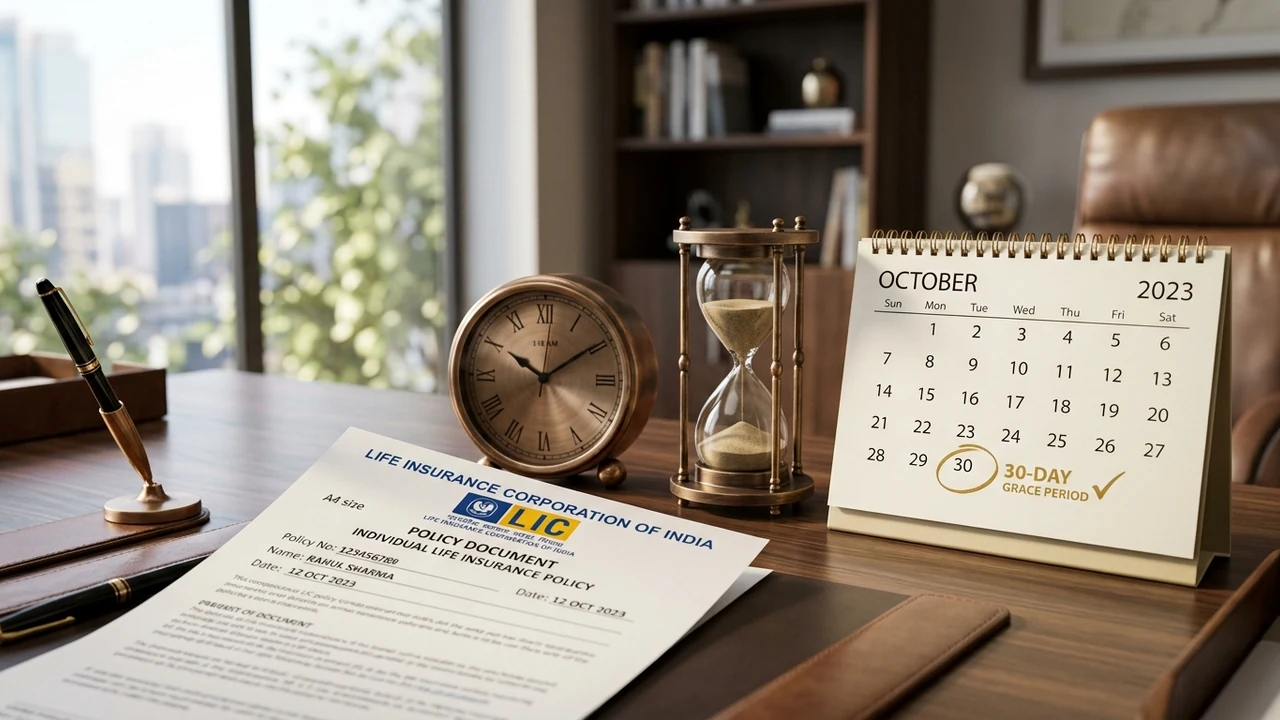
Among the millions of Indian policyholders insured under the Life Insurance Corporation of India (LIC), no acronym carries more weight than FUP (First Unpaid Premium). It is the definitive actuarial timestamp that governs whether your life insurance risk cover is active, whether your nominee is protected by statutory death benefits, or whether your contract has entered the perilous territory of policy lapse.
Life is unpredictable, and cash flow bottlenecks frequently lead to missed premium due dates. Fortunately, Indian insurance jurisprudence and the statutory clauses of LIC policy contracts provide an essential financial buffer known as the Grace Period. However, misunderstanding the exact boundaries between your due date, the grace period deadline, and the midnight lapse trigger can cost your family their entire financial safety net. This comprehensive guide breaks down the mathematical mechanics of FUP, Section 50 death claim guarantees, 9.5% late fee compounding, and the exact steps to revive a lapsed policy under LIC's Special Revival Campaigns.
1. What is FUP (First Unpaid Premium)? The Accounting Cornerstone
In LIC's core electronic database (e-FEAP), the First Unpaid Premium (FUP) date represents the exact calendar date on which the earliest unpaid premium was contractually due. Whenever you inspect your LIC policy status—whether via the LIC Customer Portal, WhatsApp service (+91 8976862090), SMS inquiry, or a branch status report—the FUP date is the single most critical data point displayed.
To understand how FUP functions, consider the following lifecycle dynamics:
- In-Force Status (Premium Paid): If your annual premium due date is October 15, 2025, and you successfully remit the payment, your FUP automatically advances by one full policy mode to October 15, 2026. Your policy status remains "IN-FORCE".
- Due Status (Within Grace Period): On October 15, 2026, the new premium falls due. Because the payment has not yet been logged, your FUP becomes October 15, 2026. Between October 15 and November 14, 2026, the policy is within the Grace Period. Your status remains legally in-force for death benefits.
- Lapsed Status (Past Grace Period): If no payment is registered by 23:59:59 on November 14, 2026, the policy transitions to "LAPSED". The FUP remains frozen at October 15, 2026. All late fees, revival interest, and medical underwriting requirements are calculated from this frozen FUP date!
Many policyholders mistakenly assume that late fee interest is calculated from the day the grace period expires. This is mathematically false! Under LIC policy contract terms, once a policy crosses the grace period and lapses, the 9.5% annual late fee is calculated retroactively from the original FUP due date, not from the end of the grace period. Paying just one day after the grace period triggers interest for the entire 31-day period!
2. Statutory Grace Period Framework: 30 Days vs 15 Days Rules
Under the IRDAI (Non-Linked Insurance Products) Regulations and standard LIC contract provisions, every policyholder is contractually entitled to an interest-free grace period. The duration of this grace window depends strictly on the Premium Frequency Mode registered under the policy:
| Premium Payment Mode | Contractual Grace Period | Late Fee Charged? | Risk Cover Status |
|---|---|---|---|
| Yearly (YLY) | 30 Calendar Days | Zero (₹0) | 100% Fully Active |
| Half-Yearly (HLY) | 30 Calendar Days | Zero (₹0) | 100% Fully Active |
| Quarterly (QLY) | 30 Calendar Days | Zero (₹0) | 100% Fully Active |
| Monthly via NACH / ECS | 15 Calendar Days strictly | Zero (₹0) | 100% Fully Active |
| Monthly Salary Savings Scheme (SSS) | 15 Calendar Days strictly | Zero (₹0) | 100% Fully Active |
| Monthly Direct (Counter/UPI) | 15 Calendar Days strictly | Zero (₹0) | 100% Fully Active |
The Critical Distinction: 30 Calendar Days vs One Calendar Month: In insurance contract law, the grace period is defined as "30 days", not "one month". For instance, if your quarterly premium is due on July 1 (a 31-day month), the 30-day grace period concludes on July 31. You do not get until August 1! Similarly, for February (which has 28 or 29 days), counting precisely 30 days extends into early March. Always calculate based on exact calendar day counts.
3. The Legal Shield: Section 50 of Insurance Act & Death During Grace Period
The single most powerful consumer protection clause in Indian insurance law is codified under Section 50 of the Insurance Act, 1938. Under this statutory mandate, an insurer cannot deny an otherwise valid death claim solely because the premium due was unpaid, provided that death occurred within the active grace period.
If the Life Assured passes away during the 30-day window (or 15-day window for monthly policies):
The Corporation is legally mandated to pay the Full Death Benefit (Basic Sum Assured + all accrued Reversionary Bonuses + Final Additional Bonus) to the designated nominee. LIC simply deducts the single unpaid premium installment from the gross payout. Zero late fee interest, zero penalty charges, and zero processing discounts can be levied against the claim proceeds!
Example Illustration: An individual holds an LIC Jeevan Labh policy with a Sum Assured of ₹20,00,000 and an annual premium of ₹85,000 due on May 10, 2026. Accrued bonuses total ₹3,40,000. The policyholder tragically dies in a road accident on June 2, 2026 (Day 23 of the grace period), having not yet remitted the ₹85,000 installment.
- Gross Contractual Death Benefit: ₹20,00,000 (Sum Assured) + ₹3,40,000 (Bonuses) = ₹23,40,000.
- Statutory Premium Deduction: ₹85,000 (Basic unpaid installment).
- Late Fee or Interest Charged: ₹0.00.
- Net Payout to Nominee: ₹23,40,000 - ₹85,000 = ₹22,55,000 directly credited via NEFT.
4. The Midnight Lapse: Day 30 at 23:59:59 & Loss of Coverage
What happens if the 30th day expires without payment? At precisely 23:59:59 on Day 30 (or Day 15 for monthly modes), the central e-FEAP ledger automatically triggers a status shift from "IN-FORCE" to "LAPSED".
This transition has devastating legal and financial consequences:
⚠️ Immediate Casualties of Policy Lapse
- 1. Suspension of Risk Cover: The primary life cover becomes null and void. If death occurs on Day 31 or later, the nominee is NOT entitled to the Sum Assured. If the policy has not completed 2 full years of premiums, 100% of all paid premiums are forfeited with ZERO payout.
- 2. Immediate Termination of Riders: All optional riders—including Accidental Death and Disability Benefit Rider (ADDB), Critical Illness Rider, and Premium Waiver Benefit (PWB)—terminate instantly upon lapse.
- 3. Halting of Reversionary Bonus Accrual: Traditional participating policies accrue bonuses on each policy anniversary only if the policy is fully in-force. Lapsed policies do not participate in LIC's annual actuarial surplus distribution.
- 4. Retroactive Penalty Accrual: An automatic late fee interest of 9.5% p.a. begins compounding half-yearly, calculated retroactively back to Day 1 (the FUP date).
5. Late Fee Calculation: The 9.5% Half-Yearly Arithmetic & 18% GST
When reviving a lapsed policy, LIC levies a statutory late fee to compensate for lost investment yields and administrative servicing. Under current operating circulars, the standard revival late fee interest is pegged at 9.50% per annum, compounding half-yearly.
Furthermore, under the Central Goods and Services Tax (CGST) and State GST acts, late fee penalties charged on life insurance contracts are categorized as financial servicing fees under SAC Code 997133, attracting an additional 18% GST.
Late Fee = Unpaid Premium × [ (1 + (r / 2))^(2 × (t / 365)) - 1 ]Where
r = 0.095 (9.5% annual rate), and t = exact days elapsed from FUP date to payment date.
Total Arrears = Unpaid Premium + Late Fee + (Late Fee × 18% GST)
Minimum Penalty Rule: Under LIC branch operating guidelines, the minimum late fee charged on any overdue transaction cannot be less than ₹5.00 + GST, regardless of how small the premium or how short the delay.
6. Actuarial Case Study: ₹25,000 Premium Lapsing Over 6 Months
To see the exact arithmetic in action, let us analyze a real-world case of an Indian policyholder who misses their payment and revives the contract after 180 days:
Case Study: 180-Day Lapse on ₹25,000 Half-Yearly Premium
• Sum Assured: ₹10,00,000
• Premium Mode: Half-Yearly (HLY)
• Installment Premium: ₹25,000 + GST
• Grace Period Closes: February 14, 2026
• Date of Revival: July 14, 2026
• Total Days Elapsed from FUP: 180 Days
*Note: If the revival is conducted within a Special Revival Campaign, this ₹1,401.25 penalty could be reduced by up to 30% under waiver slabs.
7. Special Revival Campaign Slabs: 30%, 25% & 100% Late Fee Waivers
Recognizing that millions of policies lapse due to temporary financial distress, LIC launches bi-annual Special Revival Campaigns (typically held during August-October and January-March). During these official windows, the Corporation provides significant financial concessions on accumulated late fee penalties:
| Total Premium Arrears Range | Late Fee Concession % | Maximum Cap on Waiver | Eligible Policy Types |
|---|---|---|---|
| Up to ₹1,00,000 | 30% Waiver | ₹3,000 Maximum | All Non-Linked Traditional Plans |
| ₹1,00,001 to ₹3,00,000 | 25% Waiver | ₹4,000 Maximum | All Non-Linked Traditional Plans |
| ₹3,00,001 and Above | 30% Waiver | ₹5,000 Maximum | High-Value Endowment & Whole-Life |
| Micro Insurance Plans | 100% Full Waiver | No Upper Cap | Bhagya Laxmi, Micro Bachat |
| Health Insurance Plans | 30% Waiver | ₹3,000 Maximum | Arogya Rakshak, Cancer Cover |
8. Step-by-Step Revival Pathways: Ordinary, Special & Form 680 DGH
Depending on how long your policy has been in a lapsed state, LIC categorizes revival procedures into distinct operational tracks:
If you pay your overdue premium within 6 months from the FUP date, revival is completely friction-free. You do NOT require any medical check-up, health certificate, or branch underwriting approval. You can simply pay the overdue installment plus the 9.5% late fee online via UPI, Net Banking, or at any branch counter. Your risk cover is reinstated instantly.
If your policy has lapsed for longer than 6 months, LIC mandates proof of insurability. You must complete and sign Form No. 680 (Declaration of Good Health - DGH) certifying that you have suffered no hospitalizations, surgeries, or chronic ailments. Depending on the Sum Assured and your age, LIC may accept the personal declaration or order non-medical underwriting.
For long-term lapses or where the cumulative Sum Under Consideration (SUC) exceeds non-medical branch limits, the policyholder must undergo a comprehensive medical examination conducted by an LIC-authorized Medical Examiner (TPA), including Blood Sugar, ECG, and Lipid Profiles. The maximum legal window to revive a lapsed traditional policy is strictly 5 continuous years from the FUP date.
9. Weekend & Public Holiday Extension Rules (General Clauses Act Sec 10)
A frequent dilemma encountered by policyholders occurs when the 30th day of the grace period falls on a Sunday, a Second/Fourth Saturday, or a Gazetted Public Holiday.
Under Section 10 of the General Clauses Act, 1897 and LIC's central administrative rules:
Where any statutory act or proceeding is appointed or allowed in any office on a certain day, and that office is closed on that day, the act shall be considered as done in due time if it is done on the next immediate business day upon which the office reopens.
Practical Application: If your 30-day grace period concludes on a Saturday (when all LIC branches are officially closed under the 5-day week mandate), and Sunday is also a closed day, your grace period automatically extends to 17:30 hours on the following Monday! If you remit the premium across the branch counter or via digital channels by Monday evening, the payment is treated as made within the grace period: zero late fee is charged, and your risk cover maintains unbroken continuity.
10. Embeddable Visual Decision Matrix: Grace Period to Revival Protocol
To assist policyholders, advisors, and corporate HR desks in tracking policy status and preventing unintended lapses, our actuarial team compiled the definitive decision workflow below:
LIC Grace Period, Policy Lapse & Revival Decision Tree
11. Frequently Asked Questions (8 Actuarially Validated Answers)
What is the exact grace period for monthly LIC policies?
For all monthly premium payment modes—including NACH electronic debits, ECS mandates, Salary Savings Schemes (SSS), and direct monthly payments—the grace period is strictly 15 calendar days from the premium due date, compared to 30 days for yearly, half-yearly, and quarterly modes.
Is a death claim paid if the policyholder dies during the grace period?
Yes. Under Section 50 of the Insurance Act, 1938, the full Death Sum Assured plus all accrued reversionary bonuses is legally payable to the nominee. LIC only deducts the unpaid premium installment without levying any late fee interest or penalty.
What interest rate does LIC charge on overdue premium payments?
LIC levies a standard late fee interest rate of 9.50% per annum compounding half-yearly, calculated retroactively from the FUP date once the 30-day grace period is breached. Additionally, 18% GST (SAC 997133) is charged on the calculated late fee.
What happens if the last day of the grace period falls on a Sunday or holiday?
Under Section 10 of the General Clauses Act, 1897, if the 30th day falls on a Sunday, a second/fourth Saturday, or a declared public holiday, the grace period automatically extends to the next immediate working day. You can pay on Monday without any late fee penalty.
How can I check the exact FUP date of my LIC policy online?
You can check your FUP instantly without registration by using the LIC Pay Direct portal (entering Policy Number, DOB, and Premium Amount), sending an SMS ASKLIC <PolicyNo> PREMIUM to 56767877, or sending "Hi" to the official LIC WhatsApp service at 8976862090.
What is the maximum time limit to revive a lapsed LIC policy?
Under current IRDAI product regulations, traditional non-linked policies can be revived within a maximum period of 5 consecutive years from the First Unpaid Premium (FUP) date. Beyond 5 years, a lapsed policy cannot be revived under any circumstances.
Do I need a medical test to revive my lapsed policy?
If you revive within 6 months of the FUP date, zero medical tests or declarations are required. Between 6 months and 3 years, a Declaration of Good Health (Form 680) is required. Beyond 3 years or for high sum assured covers, a full medical examination by an authorized doctor is mandatory.
What late fee discounts are offered during Special Revival Campaigns?
During official Special Revival Campaigns, LIC offers late fee waivers: 30% discount for arrears up to ₹1 Lakh (capped at ₹3,000), 25% discount for arrears between ₹1 Lakh and ₹3 Lakhs (capped at ₹4,000), and 30% discount for arrears above ₹3 Lakhs (capped at ₹5,000). Micro policies receive 100% waiver.
Content validated against Section 50 of the Insurance Act 1938, IRDAI (Non-Linked Insurance Products) Regulations 2019, General Clauses Act 1897 (Section 10), Central Goods and Services Tax Act 2017 (SAC 997133), and Life Insurance Corporation of India Master Circulars on Policy Servicing and Special Revival Schemes (FY 2026-27).