Understanding LIC Policy Loan EMIs, Semi-Annual Compounding & Foreclosure Hazards (2026)
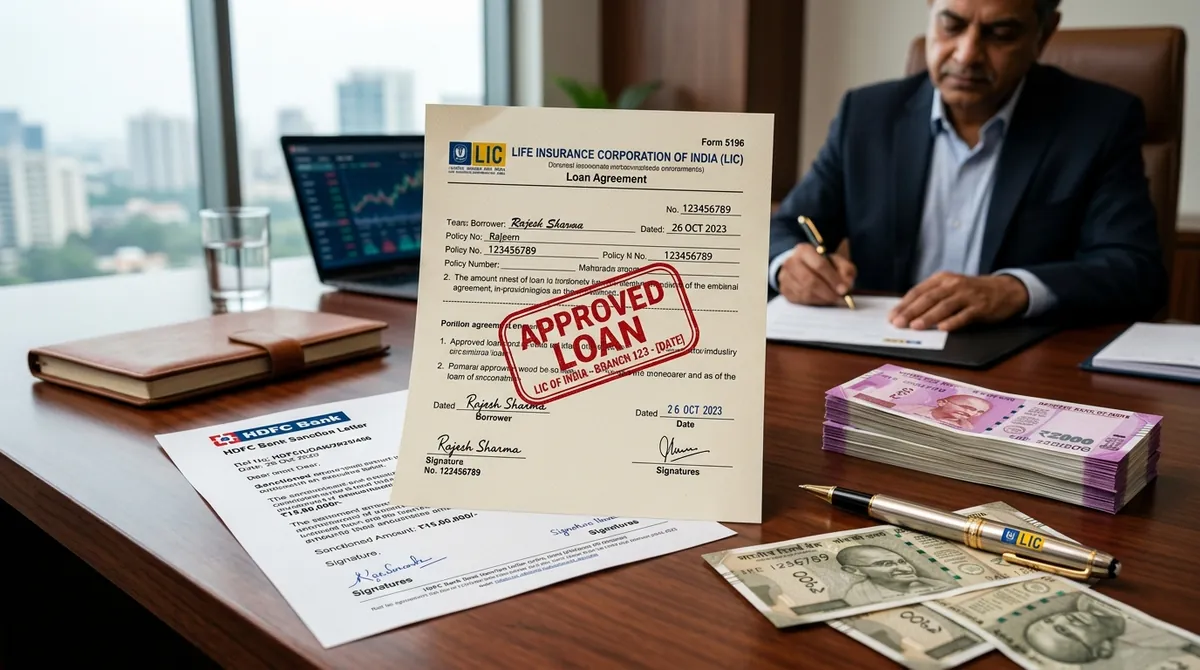
Unlike conventional personal loans or commercial mortgages governed by monthly reducing EMIs, borrowing against an LIC life insurance policy operates on a specialized actuarial model. The policyholder borrows against the accumulated surrender value equity of their participating endowment or whole life policy. Because the policy serves as sovereign-grade collateral, the repayment terms offer tremendous flexibility, but require clear understanding of the 9.50% p.a. half-yearly compounding rate.
Semi-Annual Compounding Mathematics
LIC charges an annual nominal interest rate of 9.50% p.a., compounded twice per year. If a borrower fails to pay the semi-annual interest invoice on its due date, the interest is capitalized into the principal balance:
Accumulated Debt = Principal × [1 + (0.095 / 2)]^(2 × Tenure in Years)
Effective Annual Rate (EAR) = (1 + 0.095/2)^2 - 1 = 9.73% per annum.
Policy Foreclosure Threshold
Borrowing eligibility is strictly capped at 90% of the Special Surrender Value for in-force policies, and 80% for paid-up policies.
If total debt (unpaid principal + compounding interest) ever equals or exceeds the policy's accumulated Special Surrender Value, LIC will terminate and foreclose the policy. All life insurance cover terminates immediately, and no future death or maturity benefits are payable!
Three Repayment Strategies Compared
- 1. Monthly Reducing EMI Mode:You repay both interest and principal in monthly installments. This minimizes total interest cost over the chosen 1–5 year period and steadily restores your policy equity.
- 2. Half-Yearly Interest Only (Standard LIC Route):You service only the accrued interest every 6 months. The principal remains intact, zero compounding occurs, and the principal is repaid whenever convenient or settled from claim proceeds.
- 3. Accumulating Mode (High Hazard):Zero periodic payments. Interest compounds semi-annually and grows exponentially. Ideal only for short bridge liquidity (under 12 months) before maturity.
Tax Treatment & Statutory Regulations
- No Section 80C Deduction: Unlike home loan principal repayments, repayments toward an LIC policy loan principal do not qualify for Section 80C deductions.
- Section 24(b) Restriction: Interest paid on an LIC policy loan is not deductible for personal consumption. However, if funds are deployed into business working capital or purchasing residential real estate, interest can be claimed with documentary proof verified by a CA.
- Tax-Free Net Settlement: The net proceeds paid out at policy maturity or death claim (after deducting the outstanding loan balance) remain completely tax-exempt under Section 10(10D).
Frequently Asked Questions (FAQ)
How does LIC calculate interest on a policy loan?
LIC charges interest at 9.50% per annum, compounded half-yearly (effective annual rate of 9.73%). For an interest-only structure, the semi-annual interest payment is computed as: Principal × (9.50 / 100) / 2. If left unpaid, the interest is capitalized into the principal at every 6-month interval.
Is there a mandatory monthly EMI schedule for LIC policy loans?
No. By default, LIC policy loans do NOT enforce a fixed monthly EMI schedule. Borrowers are only required to service the accrued interest every 6 months. However, borrowers seeking to eliminate debt can voluntarily establish a monthly reducing balance repayment plan using this calculator.
What is the difference between Half-Yearly Interest Only and Accumulating mode?
Under Half-Yearly Interest Only, you pay the exact accrued interest every 6 months, keeping the principal debt constant and safeguarding your policy from foreclosure. In Accumulating mode, you make zero periodic payments; the interest compounds semi-annually and grows exponentially, which risks policy termination if total debt overtakes the surrender value.
What are the maximum borrowing limits against in-force and paid-up policies?
Borrowers can sanction up to 90% of the Special Surrender Value for in-force policies where regular premiums continue to be paid, and up to 80% of the Special Surrender Value for fully paid-up policies.
Does repaying a policy loan principal qualify for Section 80C tax deduction?
No. Repayment of an LIC policy loan principal does NOT qualify for deduction under Section 80C (unlike home loan principal repayments). Furthermore, interest paid on policy loans cannot be claimed under Section 24(b) unless the borrowed capital is demonstrably utilized for purchasing or constructing a residential house property.